Aug 20, 2026
ChatGPT Ads Launch in Europe August 24: Targeting, Costs, Real Numbers

Four days from now, ChatGPT Ads go live across the European Economic Area and Switzerland, all 31 countries at once. That is sooner than most advertisers have planned for, and the ones still treating this as a later-this-year problem are about to find the auction already open without them.
Aug 24
EU and Swiss launch date, confirmed by OpenAI
31
countries covered at once
$100M
annualized ad revenue reached in under two months
600+
advertisers already running campaigns
What Actually Launches on August 24
Ads start showing to Free and Go plan users only. Plus, Pro, and Enterprise subscribers stay ad-free, which matters if you are estimating reach: you are buying the free tier, not the whole user base. Ads sit below the response text, are labeled sponsored, and are visually separated from ChatGPT's own answer.
Targeting at launch is contextual only, built from conversation topic, approximate location, device, time of day, and language. Personalized targeting, the kind that uses someone's chat history, is not part of the European launch and only arrives later if a user opts in. Two categories are excluded entirely regardless of budget: politics, and anything adjacent to health or mental health.
How Targeting Actually Works Here
This is the part worth understanding before you build a campaign, because it does not map onto Google or Meta habits at all. There is no demographic targeting. No age, no gender, no income bracket, no parental status, and you get no demographic data back on who clicked. Instead you target a taxonomy of conversation topics, things like business software evaluation, home improvement planning, or personal finance decisions, alongside geo-targeting and CPC or CPM bidding.
The pitch is that this is more precise, not less: you are describing the conversation someone is having, not guessing at who they are. In practice it means the skill that transfers from Google Ads is closer to intent-based search targeting than it is to Meta's audience-building.
- Conversation topic, from a defined taxonomy of categories
- Approximate geography, device type, time of day, and language
- CPC or CPM bidding, with custom audience matching in some markets
- Age, gender, income, or any other demographic attribute
- Behavioral retargeting based on someone's chat history, without their opt-in
- Cross-platform profiles linking a user's activity outside ChatGPT
The Numbers Advertisers Are Actually Seeing
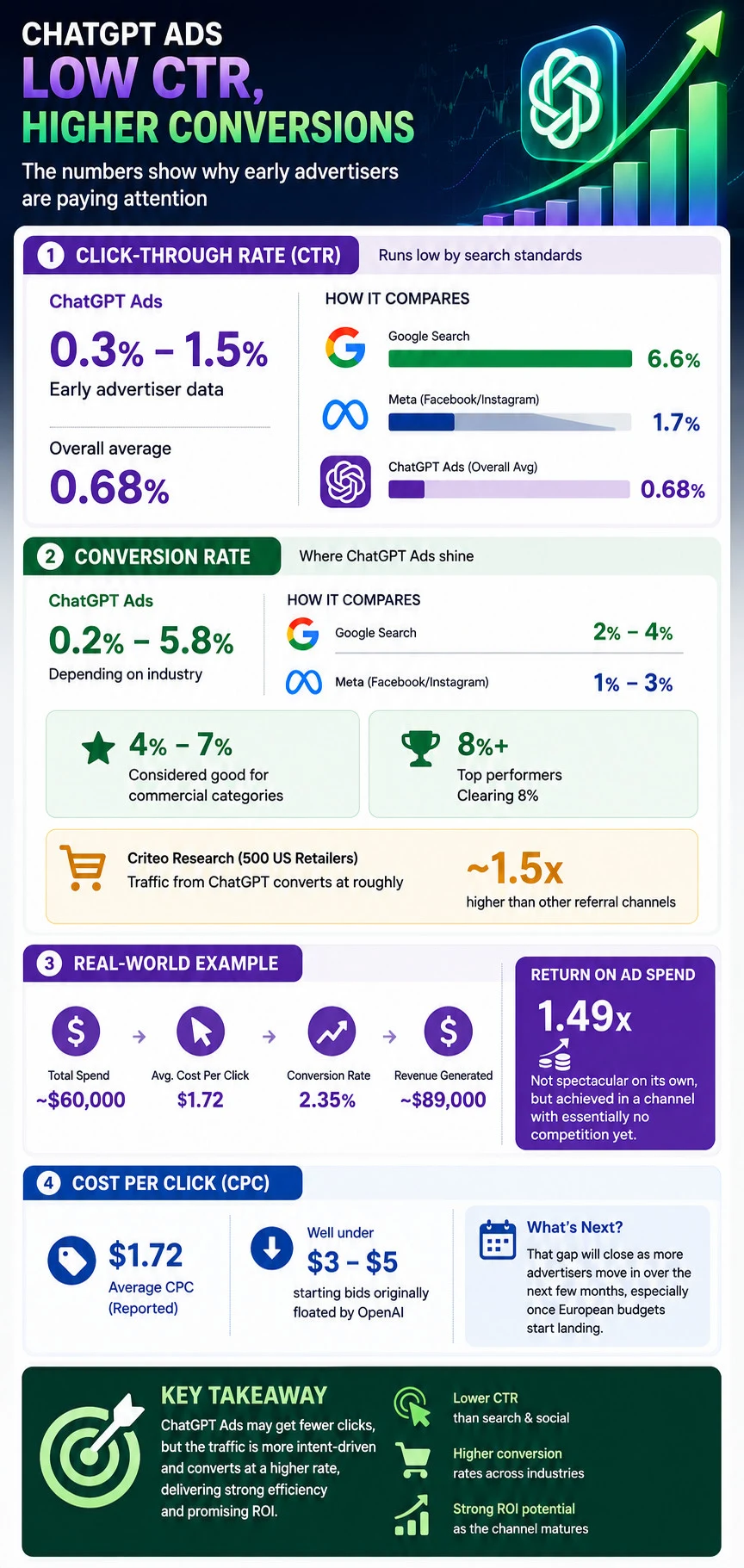
Click-through rate runs low by search standards, around 0.3% to 1.5% in early advertiser data, with a broader analysis putting the overall average at 0.68%. Compare that to roughly 6.6% on Google Search and 1.7% on Meta, and it looks weak until you look at what happens after the click. Conversion rates range from 0.2% to 5.8% depending on industry, with 4% to 7% considered good for commercial categories and top performers clearing 8%, well above the 2% to 4% typical of Google Search and 1% to 3% typical of Meta. Criteo's research across 500 US retailers found traffic referred from ChatGPT converts at roughly 1.5 times the rate of other referral channels.
One documented account spent about $60,000 at an average $1.72 cost per click and a 2.35% conversion rate, and generated roughly $89,000 in revenue, a 1.49x return. That is not a spectacular number on its own, but it came from a channel with essentially no competition yet. Average CPC has been reported around $1.72, well under the $3 to $5 starting bids OpenAI originally floated, though that gap will close as more advertisers move in over the next few months, especially once European budgets start landing.
Why Adoption Has Been Uneven
Not every rollout has gone smoothly. When ChatGPT Ads opened to Shopify merchants on a self-serve basis, only about a dozen of the platform's millions of merchants actually went live, and OpenAI shifted its near-term focus back toward larger app partners like Instacart, Target, Expedia, and Booking.com instead. The lesson is not that the format does not work. It is that a genuinely new ad platform, with no keyword research tools, no mature reporting, and targeting built on a taxonomy nobody has memorized yet, has real friction for a small advertiser trying to self-serve without guidance.
What To Do Before August 24
- Start with a contained test budget. Most early advertisers are running $5,000 to $25,000 to gather enough data on CTR and cost per conversion before committing more.
- Write for the topic taxonomy, not for keywords. Map your product to the conversation categories where it is genuinely relevant, the way you would plan search intent, not the way you would build a Meta interest list.
- Set expectations around CTR, not against it. A lower click-through rate here is not a red flag if conversion quality holds, and early data suggests it usually does.
- If you sell into regulated categories, check the exclusion list first. Health, mental health, and political content are out regardless of how contextual your framing is.
We already covered the mechanics of the ad objectives and pixel setup in our first look at ChatGPT Ads. This is the part that changes on August 24: 31 new countries of inventory go live overnight, and almost none of your competitors have run a single euro through it yet.
Want results like this for your brand?
Get a free strategy call and a tailored proposal within one business day.
Get a Free Proposal