Case Study - Google Ads
$5 Cost-Per-Lead Google Ads Campaign for a US Auto Auction Sourcing Company
AutoBid Direct helps international buyers source, bid on, and export vehicles from major US auto auctions like Copart and IAAI. Here's exactly how we rebuilt their Google Ads account to turn a leaking budget into a predictable lead machine.
$5
Cost Per Lead
$100
Daily Budget
185%
Lead Volume Increase
Client
AutoBid Direct
Industry
Vehicle Sourcing & Export
Channel
Google Ads (Search)
The challenge
AutoBid Direct helps buyers who can't attend US auto auctions in person - Copart, IAAI, and similar platforms - source vehicles, place winning bids on their behalf, and handle export logistics. It's a high-ticket, trust-dependent service, and the keywords around it are brutally mixed intent: someone searching "how to buy a car from Copart" might want to hire a sourcing service, or might just want a free tutorial to do it themselves.
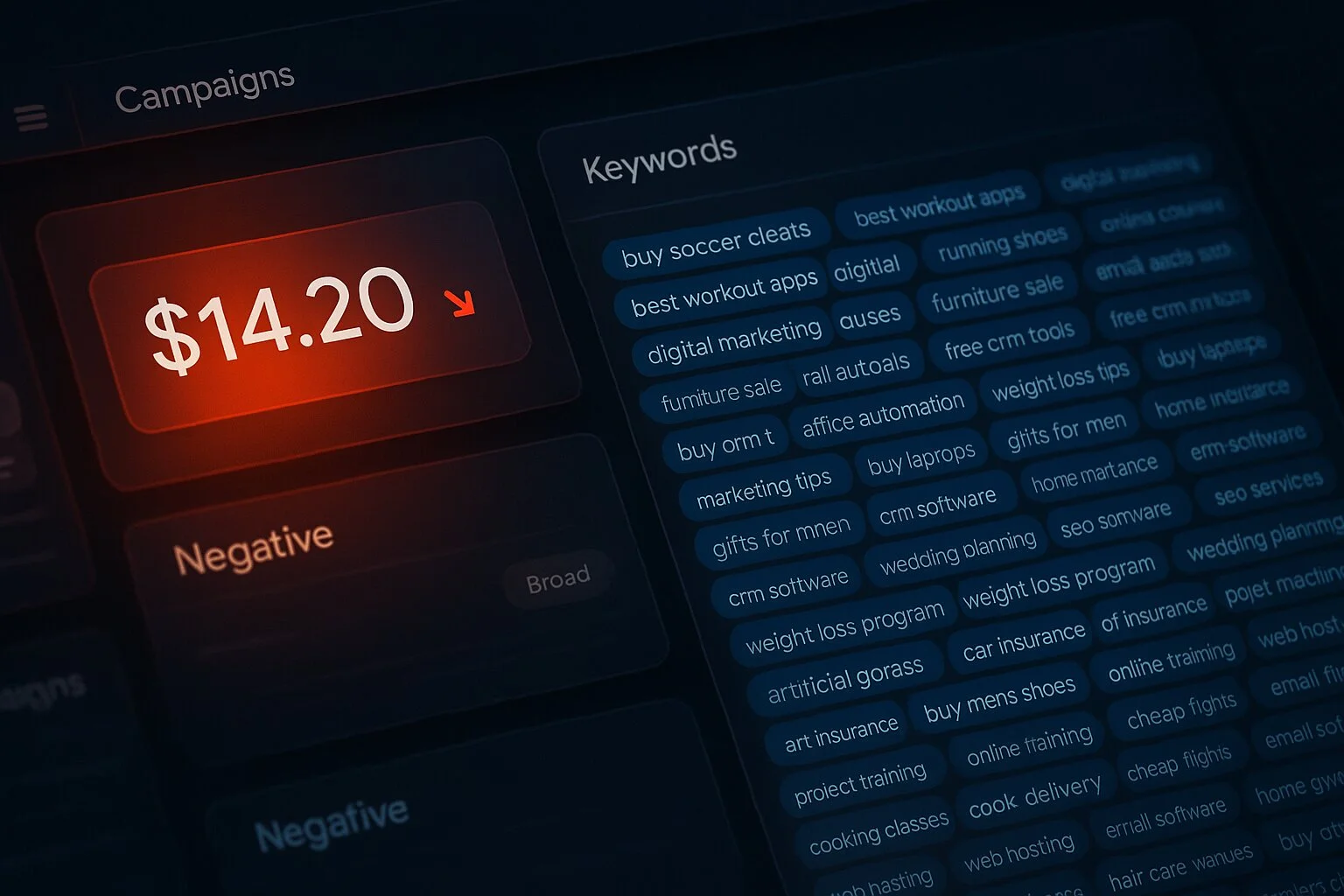
The account we inherited was spending the full $100/day budget on a handful of broad-match campaigns with almost no negative keyword coverage. The result: a cost per lead north of $14, a landing page with no clear differentiation from a DIY guide, and zero call tracking - so nobody could say which keywords were actually producing paying customers versus tire-kickers.
Our strategy
We rebuilt the account around one principle: intent precision beats volume. That meant splitting the single broad-match campaign into tightly themed ad groups - one per auction platform, one per vehicle category (sedans, SUVs, trucks, salvage/rebuildable titles) - each with its own landing page section and call-to-action.
Just as important was what we excluded. We built an aggressive, continuously updated negative keyword list to filter out "how to," "for free," "DIY," and "auction license" searches - people looking to bid themselves, not hire someone to do it. That single change removed a large share of unqualified clicks before we touched a single bid.
Finally, we wired up call tracking and a CRM-integrated lead form so every dollar of spend could be traced to a real, sales-qualified conversation - not just a form submission.
What The Ad Experience Looked Like
One ad group, one clear promise.
Instead of one generic ad pointing at a generic page, each ad group's copy mirrored the exact search - landing on a page section built for that specific offer.
Copart Auction Sourcing - We Bid, You Choose
Full-service bidding, inspection, and export. Get a free vehicle shortlist today.
Execution Timeline
What we actually did, step by step.
Click any phase for the detail.
Weeks 1-2 Audit & Tracking Foundation
Full audit of the existing account structure, search terms report, and landing page. Installed Google Tag Manager, call tracking, and CRM-integrated lead form tracking so every conversion could be traced back to source keyword. Built the first pass of the negative keyword list from 90 days of search term data.
Weeks 3-4 Campaign Rebuild
Split the single broad-match campaign into themed ad groups by auction platform (Copart, IAAI) and vehicle category. Rewrote ad copy to mirror exact search intent, and restructured the landing page into dedicated sections matching each ad group's promise.
Weeks 5-8 Launch & Learning Phase
Relaunched under the same $100/day budget to isolate structure and targeting as the only variables. Reviewed search term reports twice weekly, expanding the negative keyword list and pausing ad groups that failed to produce sales-qualified calls within two weeks.
Weeks 9-12 Optimize & Scale
Doubled down on the two ad groups producing the lowest cost per sales-qualified lead, tested three landing page variants against each other, and layered in call-only ad extensions for mobile searchers ready to talk immediately.
Before vs. after
"We were burning the same $100 a day for worse results before. Korf Digital didn't ask for more budget - they just stopped us paying for the wrong clicks."
Daniel K.
Founder, AutoBid Direct
Want results like this?
Tell us about your goals - we'll show you exactly how we'd approach your account.
Get a Free ProposalFrequently asked questions
Can Google Ads work for a niche business like auto auction sourcing?
Yes - niche, high-consideration services often perform better on Search than broad consumer products, because the searcher already knows exactly what they want. The key is keyword precision and aggressive negative-keyword filtering to exclude people who want to bid themselves rather than hire a service.
How much daily budget do I need to see results like this?
This account ran on $100/day. Smaller budgets can still work, but they slow down the learning phase since the algorithm needs a minimum volume of conversions per week to optimize bidding effectively - we typically recommend at least $50-70/day as a starting point for a similar service business.
How long did it take to reach a $5 cost per lead?
The account reached a stable $5 CPL within 90 days. The first month focused on tracking and negative-keyword cleanup, the second on creative and landing page testing, and the third on scaling the winning ad groups.
Do you work with export, import, or other logistics-heavy service businesses?
Yes. Vehicle sourcing and export is one of several logistics-heavy, high-ticket service categories we manage - the same tracking and keyword-filtering approach applies to freight forwarding, equipment import, and similar B2B sourcing services.
What made the biggest difference in cutting cost per lead?
Two things: rebuilding the negative keyword list to remove DIY bidders searching to bid themselves rather than hire a service, and moving from a single broad-match campaign to tightly themed ad groups matched to specific auction platforms and vehicle categories.
Oct 12, 2026
How to Calculate ROI, ROMI and ROAS: Formulas, Examples and Free Calculators
A 400% ROAS can still lose money. What ROAS, ROMI and ROI really measure, the exact formulas, break-even ROAS by margin, and five free calculators for ecommerce and lead generation.

Oct 10, 2026
Google Ads for Real Estate Agents 2026: "Sell My House" Costs $150 a Click, "Homes for Sale" $1.51
Seller searches are bid up by cash buyers, buyer searches go to the portals. Real CPC data for realtors and UK estate agents, why home valuation searches are the affordable route to listings, budget math and setup.