Sep 1, 2026
Google Ads and Meta Ads Benchmarks 2026: CPC Is Up 12%, CPM Up 20%
A fresh 2026 benchmark analysis of over 13,000 Search campaigns across 23 industries, covering April 2025 through March 2026, confirms what most accounts have already felt in their invoices: paid ads got meaningfully more expensive this year. Google Ads CPC rose 12% year over year, the steepest annual jump since 2021, and Meta's CPM climbed even harder, up 20%. Here's what the actual numbers show, and what's driving costs up specifically now.
+0%
Google Ads average CPC increase year over year, the steepest since 2021
+0%
Meta Ads average CPM increase year over year, from $11.82 to $14.19
13,000+
Search campaigns analyzed across 23 industries for this benchmark
$66.69
cross-industry average cost per lead on Google Ads in 2026
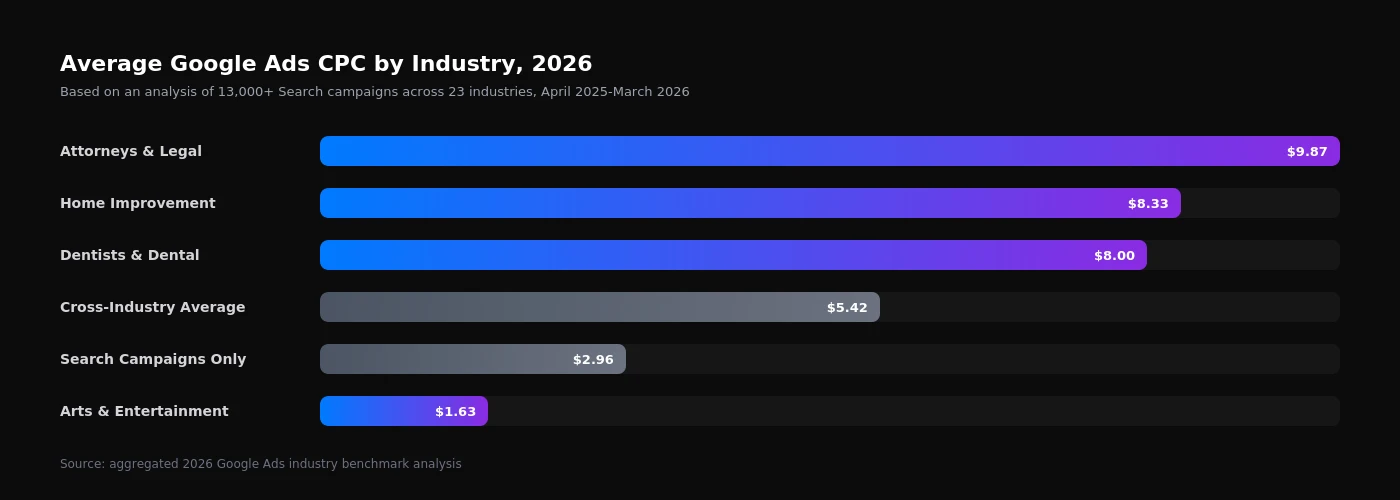
Why Attorneys Pay 6x More Per Click Than Arts and Entertainment
The gap between the most and least expensive industries in this data isn't random, it tracks almost exactly with customer lifetime value. A single client is worth thousands of dollars to a law firm or a home improvement contractor, which means the auction supports bidding far higher per click before it stops being profitable. Arts and Entertainment sits at the opposite end for the same reason in reverse, low per-customer value caps how much anyone can rationally bid, keeping the whole category's CPC compressed regardless of how much overall demand exists.
What's Actually Driving the 12% Jump
Two forces are compounding at once. First, competition for AI-optimized placements, AI Max, Performance Max, and Advantage+ inventory, has intensified as more advertisers shift budget into these automated formats, and auctions with more sophisticated bidders competing for the same automated inventory tend to push prices up faster than traditional keyword-level competition did. Second, Google's own AI Overviews are absorbing a growing share of organic clicks that used to be free, which pushes more total demand toward paid placements to recover the same traffic, a mechanical effect that raises average CPC independent of any change in advertiser behavior at all.
Google Ads vs. Meta Ads: Where the Pressure Is Higher
CPC up 12% to $5.42 average, CTR holding at 6.64%, conversion rate actually improved to 8.18%, and cost per lead declined to $66.69. The pattern here is rising acquisition cost per click offset by better downstream efficiency, automation is getting more expensive to access but converting what it delivers more effectively than a year ago.
CPM up a steeper 20% to $14.19, CPC up 11% to $1.72, CPA landing around $38.19. Tier-1 markets show the widest spread, U.S. CPM alone reaching roughly $23, meaning geographic targeting decisions now carry more cost weight than they did a year ago.
Year-Over-Year Cost Increases, Side by Side
What This Means for Your Budget Planning
- A flat budget now buys meaningfully less reach than it did a year ago. If your budget hasn't moved but your CPC has risen with the market, your actual impression and click volume has quietly shrunk even though spend looks unchanged.
- The gap between optimized and unoptimized accounts is the widest it's been. With automation now the default competitive baseline, an account still running manual bidding or unrefined targeting is competing at a structural disadvantage against accounts using the full automated feature set.
- Improving downstream conversion rate now matters more than fighting CPC directly. Since Google's own data shows conversion rate improving even as CPC rises, the accounts pulling ahead are the ones improving landing pages and offer quality, not just bidding more aggressively.
Frequently Asked Questions
Is this CPC increase happening across all industries equally?
No, high-LTV industries like legal and home services already had high CPCs and saw the increase compound on an already-expensive baseline, while low-LTV categories like arts and entertainment saw comparatively smaller absolute increases.
Does higher CPC mean advertising is becoming less worthwhile?
Not necessarily, the same data shows conversion rates improving and cost per lead declining overall, meaning the cost per click is up but the efficiency of what that click produces has held up or improved.
Should I shift budget from Google to Meta given Meta's CPC is lower?
Not based on this data alone, CPC and CPM aren't directly comparable across platforms with different objectives and audiences, the right split depends on which platform actually converts for your specific offer, not just which one shows a lower unit cost.
Rising costs across both platforms make the gap between an optimized and unoptimized account more expensive to ignore than it was a year ago, since the same budget increasingly buys less unless the account is extracting maximum efficiency from every dollar. If you want your account benchmarked against your specific industry's numbers rather than the cross-industry average, our Google Ads team can review where you actually stand.
Want results like this for your brand?
Get a free strategy call and a tailored proposal within one business day.
Get a Free Proposal