Sep 7, 2026
How Much Do Facebook and Instagram Ads Cost in 2026?

Advertising on Instagram and Facebook looks cheap to start, and that is precisely the trap. You can spend twenty dollars, tap Boost inside the app, and watch impressions arrive within the hour. What that simplicity hides is that a boosted post and a properly structured campaign in Ads Manager produce very different results for the same money, and the gap in cost per lead between them is routinely threefold. Here is what Meta advertising actually costs in 2026, what the money is spent on, and where it quietly disappears.
$0.19
blended average cost per thousand impressions, up from $11.82
$0.72
average cost per click, an 11% increase year over year
+0%
year-over-year rise in CPM driven by competition and privacy limits
0
weekly conversions an ad set needs to exit the learning phase
A realistic working minimum for Meta advertising is $1,000-$1,500 per month all-in: roughly $700-$1,000 in ad spend plus $300-$500 for management on the low end. Blended CPM sits near $14.19 and CPC near $1.72, though lead-gen clicks average $1.92 and European campaigns typically run EUR 10-12 CPM with sub-EUR 1 clicks. The single biggest cost driver is not targeting, it is creative quality.
What impressions cost across markets
Meta prices vary enormously by geography, and understanding where you sit changes what a "good" cost per result even means.
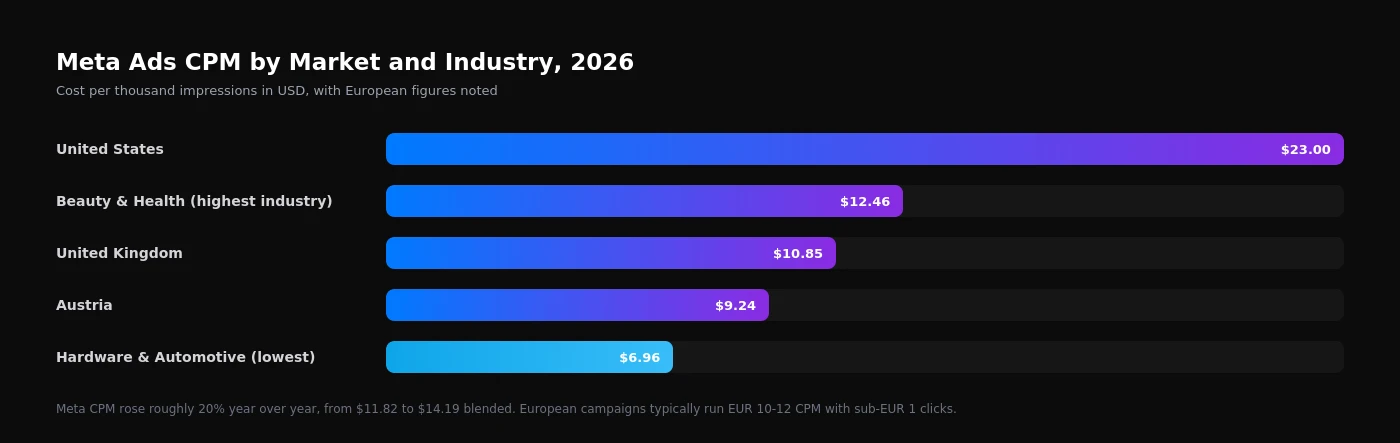
Industry matters as much as country. CPM ranges from about $6.96 in hardware and automotive to $12.46 in beauty and health, while cost per click spans $0.45 in apparel to $3.77 in finance. Cheaper impressions do not automatically mean cheaper customers: finance pays more per click because a converted customer is worth vastly more, and apparel pays less because margins are thinner. The metric that matters is cost per acquisition against your margin, not CPM in isolation.
Within Europe the spread is just as wide. CPM in Germany and the Nordics typically runs €7-€12, in Spain and Italy €4-€7, and in Central and Eastern Europe €1.50-€4. A campaign that looks expensive in Munich and cheap in Bucharest may deliver identical cost per customer once average order value is taken into account.
The three parts of your budget
- Money charged for impressions and clicks
- Billed directly to your card
- Roughly $25 daily minimum for stable learning
- Your marketer never receives this
- Campaign structure and launch
- Audience and creative testing
- Daily monitoring of cost per result
- Reporting tied to cost per lead
- Video for Reels and Stories
- Static images and carousels
- Filming or editing
- The most commonly forgotten line item
That third column is the structural difference from Google Ads. A search ad headline is written once and works for months. Meta creative burns out: the same audience sees a video several times, stops responding, and cost per result climbs. Producing new creative is a recurring monthly expense, not a launch cost, and budgets that ignore this run out of performance around month two.
Price depends on your campaign objective
Meta charges differently depending on what you ask the system to optimise for. The closer the objective sits to actual revenue, the more each result costs.
| Objective | What you pay for | Typical cost | When it fits |
|---|---|---|---|
| Reach | Thousand impressions | $7-$23 CPM | Brand awareness, event announcements, launches |
| Traffic | Click to site | $0.45-$1.50 | Building retargeting pools, content distribution |
| Engagement | Reaction, comment, view | $0.02-$0.20 | Warming an audience, social proof on posts |
| Leads | Completed form | $5-$80 | Services, bookings, consultations, courses |
| Sales | Purchase on site | $18-$60 CPA | Stores with Pixel and Conversions API configured |
Choosing the Traffic objective instead of Leads or Sales because clicks look cheaper. Meta will do exactly what you asked: deliver the maximum number of cheap clicks from people who enjoy clicking and never buy. Cheap traffic that does not convert costs more than expensive clicks that do.
What actually drives your price
Two advertisers with identical budgets and identical audiences routinely pay twice different amounts per result. The gap comes down to a handful of factors, and creative sits at the top of the list.
What makes it more expensive
- Weak creative. The largest multiplier of all. If the first three seconds do not hold attention, Meta serves the ad less often and charges more for each impression.
- Over-narrow audiences. Restricting delivery to a few thousand people removes the algorithm's room to manoeuvre, and every impression costs more.
- Creative fatigue. Once frequency passes three or four, response falls and cost climbs steadily.
- No Conversions API. Without server-side tracking some conversions never reach Meta, so optimisation runs on partial data.
- Constant edits. Every significant change restarts the learning phase and spends budget re-learning what it already knew.
What makes it cheaper
- Several different creatives at launch. Three to five genuine variants give the system something to choose between, and it finds the winner quickly.
- Vertical video shot on a phone. Frequently outperforms expensive production because it looks native in the feed.
- Broad audiences plus strong creative. Modern algorithms find buyers themselves when not constrained by excessive targeting rules.
- Excluding existing customers. Not paying to re-reach people who already bought is the simplest saving available.
- Running ads from existing organic posts. A post carrying real likes and comments earns trust and converts more cheaply.
How the auction works and why your bid is not the main factor
Meta does not sell impressions to whoever pays most. The system weighs three things together: your bid, the estimated likelihood that the person takes the action you want, and how genuinely interesting the ad is to that user. The winner is the best combination, not the biggest number.
The practical consequence matters more than it sounds. If your creative holds attention and people react to it, Meta will serve it more cheaply than a competitor with a larger budget and a dull banner. Which means work on the video affects campaign economics more than any amount of audience-setting adjustment.
Three diagnostics in Ads Manager show how the system rates your ad:
- Quality ranking. Compares your ad against others competing for the same audience. Low ranking means the creative is losing on engagement.
- Engagement rate ranking. Predicted likelihood someone clicks, reacts or comments.
- Conversion rate ranking. Predicted likelihood someone completes the action after clicking. Your landing page influences this one, not just the ad.
If all three sit below average, raising the budget fixes nothing: you simply spend the same inflated price faster. The correct response is new creative, not a higher bid.
Minimum budget: what the algorithm needs
The binding constraint in Meta is data, not money. An ad set needs roughly fifty conversions per week to exit the learning phase and perform predictably. The minimum budget follows from that arithmetic.
If your target cost per lead is $10, fifty weekly leads cost $500, which is about $2,000 monthly. For most small businesses that is too much, so in practice people run smaller and accept a longer, less stable learning period. That is a legitimate trade-off as long as it is a conscious one.
| Daily budget | Monthly | What to expect |
|---|---|---|
| $5-$10 | $150-$300 | Awareness and retargeting only. Not enough data for conversion optimisation |
| $25-$40 | $750-$1,200 | Working minimum for lead generation in a single market |
| $60-$100 | $1,800-$3,000 | Stable performance with room to test audiences and creative |
| $150+ | $4,500+ | Scaling, multiple funnels running in parallel |
How long until stable results
Meta needs less time than SEO, but more than a business owner who launched last night and is checking results this morning expects.
| Period | What is happening | What to do |
|---|---|---|
| Days 1-3 | Learning phase. Cost per result swings wildly | Change nothing. Every edit restarts learning |
| Days 4-10 | The system finds audience pockets, price starts settling | Watch which creatives are getting delivery |
| Days 11-21 | Cost per result stabilises | Turn off weak creative, introduce new variants |
| Month 2 | Early fatigue appears, frequency climbs | Refresh creative, widen the audience |
The rule that saves the most money: draw no conclusions before fifty conversions. Below that threshold the difference between a good week and a bad week is mostly noise, and reacting to noise costs more than sitting still.
Costs by business type
What matters for a store barely registers for a local service, and the reverse. Budgets and priorities differ accordingly.
From $2,000 monthly
The foundation is a product catalogue connected to Meta plus dynamic retargeting: someone viewed a pair of trainers, they see those exact trainers again. This is the cheapest conversion type available on the platform.
Pixel and Conversions API together are non-negotiable. Without server-side tracking a share of purchases goes unrecorded, the algorithm sees less data and optimises worse, and you see understated results and draw the wrong conclusions from them.
$1,000-$3,500 monthly
Lead generation through instant forms or click-to-message. Leads cost $5-$80 depending on the category, but the more important point is that instant-form leads are typically lower quality than site leads, precisely because they are so easy to submit.
Response speed is therefore critical. A Meta lead has a shelf life measured in hours, not days: the person saw your ad incidentally rather than searching you out deliberately.
$600-$1,500 monthly
A delivery radius around the location, simple creative, a clear offer and the address up front. For a cafe, salon or gym this is usually enough, and local auction competition is noticeably softer than national.
Video showing the actual place and real people outperforms studio banners consistently. The audience needs to recognise the neighbourhood and understand it is nearby.
Two worked examples
Language school, lead generation
A school advertises a free trial lesson in one city.
- Ad spend: $600 monthly
- Cost per lead: $8, giving about 75 leads
- Show-up rate: 40%, so 30 trials
- Enrol: 30% of those, so 9 students
- Cost per student: roughly $67 in ad spend
- Management and creative: $400
- Total: $1,000, or $111 per enrolled student
With a course priced at $400 the channel works comfortably. But notice the gap between an $8 lead and a $111 student: most of the loss happens between enquiry and payment, not inside the ad account. Optimising follow-up speed usually beats optimising campaigns.
Fashion e-commerce store
Selling nationally with a catalogue and dynamic retargeting.
- Ad spend: $2,500 monthly
- Cost per purchase: $22, roughly 113 orders
- Average order value: $70 at 45% margin
- Gross profit: roughly $3,560
- Management and creative: $1,000
- Total cost: $3,500
Profit after advertising is marginal, which is typical for apparel at 45% margin. This model survives on repeat purchases: the first order barely covers acquisition, the second and third generate the actual profit. Without repeat business the arithmetic does not close.
Where budget disappears
Across account audits, losses concentrate in a small number of predictable places.
- Campaigns nobody switched off. A promotion ended three months ago and the ad still runs, pointing at a page with outdated pricing.
- Showing ads to existing customers. Without excluding purchasers you pay monthly to remind people about a product they already own.
- Overlapping audiences in one account. Two ad sets target similar people and compete against each other in the auction, raising your own costs.
- Unreviewed automatic placements. A meaningful share of budget sometimes flows to placements where your format simply looks wrong.
- Vertical video in horizontal placements. The crop cuts text out of frame and the ad becomes unreadable without anyone noticing.
- Leads nobody follows up. The most expensive loss of all: you pay for the enquiry, it waits two days for a reply, and goes to a competitor.
If you generate 100 leads a month at $10 each, and half of them wait more than two hours for a response, you are effectively discarding $500 monthly. That is more than most small businesses spend on campaign optimisation. Response speed frequently produces a bigger lift than any targeting change.
What creative costs
This is the line item planned last and exhausted first. Typical market rates:
| Format | Price per unit | Monthly volume needed |
|---|---|---|
| Static image ad | $30-$120 | 3-5 variants |
| Carousel set | $60-$250 | 1-2 sets |
| Video edit from existing footage | $80-$400 | 2-4 clips |
| Purpose-shot video | $500-$4,000 | One shoot day per quarter |
| Creator or UGC content | $100-$2,000 | As needed |
The cheapest genuinely effective creative in 2026 is vertical video shot on a phone by a staff member or a customer. It costs almost nothing, looks native in Reels, and routinely beats studio production on cost per result. Start there and move to expensive production only once you know which message works.
Pre-launch checklist
Half of failed launches fail on infrastructure rather than campaign settings. Work through this before spending anything.
- Business Manager owned by your company. Not by an agency's personal profile or a former employee. The ad account, page and Pixel must belong to you.
- Pixel installed and verified. Not just code pasted in, but events confirmed arriving in Test Events. Takes minutes to check.
- Conversions API connected. Without it a share of conversions is lost to browser restrictions and the algorithm learns from incomplete data.
- Domain verified. Required for conversion optimisation to work correctly under current privacy rules.
- At least three genuinely different creatives. Not one banner in three colours, but different approaches: a video, a static, a carousel.
- Landing page checked on a phone. Over 90% of Meta traffic is mobile. An awkward mobile form cannot be fixed by better targeting.
- A defined target cost per lead. Without that number you cannot judge whether the campaign works and will decide on feel.
- Someone answering enquiries during business hours. Obvious, and still the most common reason advertising "does not work."
What managers charge
- Junior freelancer: $200-$500 monthly. Fine for simple tasks and small budgets, but expect limited analysis.
- Experienced freelancer: $500-$1,500 or 10-15% of spend. The sweet spot for most small businesses.
- Agency: $1,500-$5,000 or 12-20% of spend. Justified when you need a team: strategist, designer and analyst separately.
- One-off setup: $400-$1,500. Launch without ongoing management. Works as a start only, since performance degrades without supervision.
Warning signs
- Guaranteed sales volume before any testing. Nobody knows your cost per lead until the first few hundred dollars have been spent.
- Running ads from a personal account rather than Business Manager. You get no access to data, no Pixel history, and lose everything if the account is restricted.
- Reports showing only reach and impressions. Those metrics are easy to make look impressive. The question is always cost per lead.
- Reluctance to set up Conversions API. It is a baseline requirement now, not an upgrade.
Frequently asked questions
How much do Facebook and Instagram ads cost per month?
A realistic working minimum is $1,000-$1,500 all-in: roughly $700-$1,000 in spend plus $300-$500 in management. Instagram and Facebook run from one account and share a budget, so they are not usually costed separately.
Can I just boost posts from the app?
You can, and it is the most expensive way to advertise. Boost offers minimal controls, cannot properly optimise for conversions, and hides the reporting you need. Acceptable for a one-off event announcement, unsuitable for systematic work.
Why did my cost per lead jump without any changes?
Usually creative fatigue: check frequency, and if it has passed three, refresh the video. Second cause is seasonal auction pressure, for example November before the holidays. Third is a site change that broke the form while clicks continued.
How many creatives should I test at once?
Three to five at launch. Fewer gives the system no choice; more splits the budget so thinly that no variant accumulates enough data to judge.
Is Meta cheaper than Google Ads?
Clicks are almost always cheaper, sometimes several times over. But someone scrolling a feed was not looking for your product, so the path to purchase is longer. Where demand already exists, Google usually delivers a cheaper lead. Where demand must be created, Meta wins.
Do I need a separate retargeting budget?
Yes, and it is one of the most profitable allocations available. Bringing back people who already visited costs a fraction of acquiring new ones. A typical split assigns 15-25% of total budget to retargeting.
Does my follower count affect ad costs?
Not directly, the auction does not price by page size. Indirectly it does: an ad running from an active page with real reactions and comments earns more trust, gets more clicks, and higher engagement lowers delivery cost. That is why running ads from an existing organic post usually outperforms building a fresh ad.
Does a $300 monthly budget make sense?
For conversions, almost never. Ten dollars a day buys roughly fifteen to twenty-five clicks, far too few for the algorithm to leave the learning phase. That budget makes sense for exactly two jobs: warming a small audience ahead of a specific launch, or retargeting people who already visited your site. Retargeting pools are small, so they need little budget, and it is one of the few scenarios where $300 genuinely works.
What does it cost to advertise in several countries at once?
More than expected, and not only because rates differ. Each country needs its own creative in the local language, its own ad set, and its own budget for the learning phase. A practical rule: do not run more than two or three countries simultaneously until monthly spend exceeds roughly $3,000, otherwise none of them accumulates enough data to optimise.
How do I know whether creative fatigue has set in?
Watch frequency alongside cost per result. When average frequency passes three and cost per result is climbing at the same time, the audience has seen the ad too often. That combination, rather than either metric alone, is the reliable signal that it is time for new creative rather than a bigger budget.
Can I reuse the same creative from TikTok?
Partly: vertical video technically fits both platforms. But the pacing differs, and a clip that performs on TikTok often feels too fast in Reels, while a calmer Reels edit gets scrolled past on TikTok. The sensible approach is to shoot once and edit separately for each platform. That barely increases the cost and noticeably changes the result.
Should I run ads from a new page with no followers?
You can, and the auction does not check your follower count. But a page with no posts, no photo and no history lowers trust the moment someone taps through, and that shows up in conversion rather than in impression costs. Spend an hour filling in the profile and publishing a few real posts before the first campaign; it costs nothing and removes an obvious objection.
Why does Meta charge me after I paused the campaign?
Billing lags delivery: you are charged for spend already incurred once a payment threshold is reached. An invoice arriving after you pause covers previous days rather than indicating an error, which is why the final charge on a stopped campaign almost always lands a few days late.
The cost of Meta advertising is set by creative quality and tracking accuracy far more than by any rate card. If you want a realistic budget forecast for your market before launching, our Meta Ads team can model expected cost per lead. If campaigns are already running but the data looks incomplete, start with setting up the Conversions API, because without it a meaningful share of conversions never reaches the system at all.
Want results like this for your brand?
Get a free strategy call and a tailored proposal within one business day.
Get a Free Proposal