Sep 7, 2026
How Much Does SEO Cost in 2026? Real Pricing Breakdown

SEO is sold strangely. With Google Ads you can see what a click costs and switch the campaign off any day you like. With SEO you are quoted a monthly retainer, asked for six months of patience, and promised rankings that nobody actually controls. So "how much does SEO cost" usually turns into comparing proposals where one agency wants $800 a month, another wants $6,000, and neither fully explains why. Here is what that number is actually made of, what each budget level buys, and how to tell real work from an invoice.
$0
average monthly retainer across a survey of 439 SEO providers
0%
of providers price monthly work between $500 and $5,000
0-0 mo
typical time before traffic changes become clearly visible
$0
average hourly rate for a senior consultant in Western Europe
Most businesses pay $1,000 to $5,000 per month for SEO. Small businesses typically land at $2,500-$5,000, mid-market companies at $5,000-$10,000, and enterprises at $10,000-$50,000 or more. In the DACH region agencies commonly quote EUR 1,500-5,000 monthly, with specialists above EUR 8,000. Hourly consulting runs $75-$300. Judge SEO on a twelve-month horizon, not a three-month one.
Why quotes differ by a factor of five
The core confusion is that the word "SEO" covers at least three different scopes of work, and proposals rarely separate them.
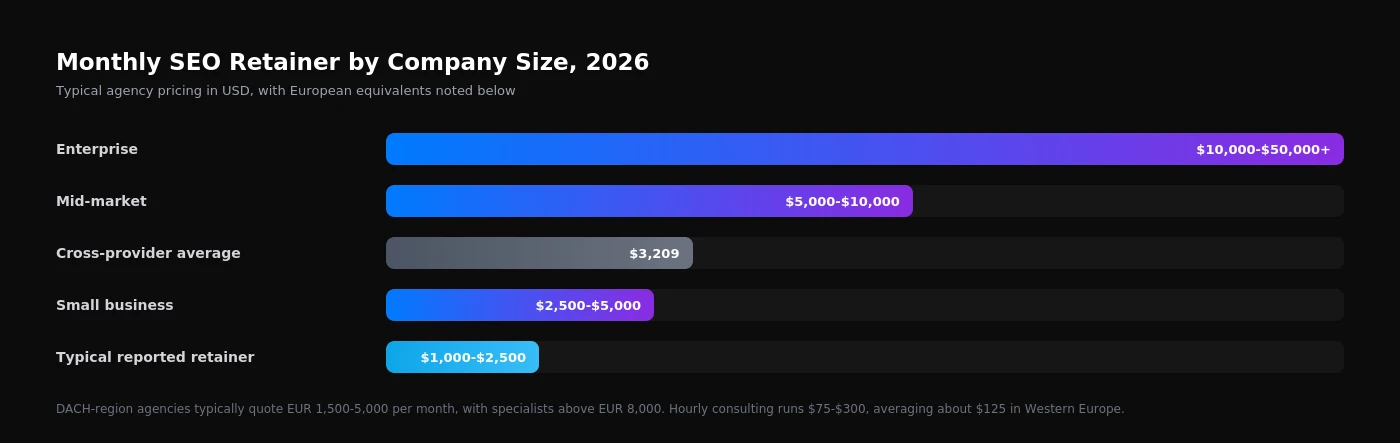
At $800 a month you are buying a few hours of one person's week, spent fixing technical errors and rewriting meta tags. At $6,000 you are buying a team: a technical specialist, a writer, and someone doing outreach, with a real budget for content and placements. Those are different services sharing a name, which is exactly why comparing them on price alone tells you nothing.
What the retainer is actually spent on
When a budget is allocated sensibly it splits roughly as follows. These proportions are worth asking any prospective agency about directly.
This explains something important: a large share of an SEO budget is not salary, it is procurement. Placements and content production cost real money. If a $2,000 proposal has no line item for links or content, one of two things is true. Either that work is not happening, or it is being absorbed into the specialist's hours, leaving very little for actual strategy.
What each budget level buys
- Technical audit and critical fixes
- Optimising 10-20 key pages
- Google Business Profile work
- 2-4 pieces of content monthly
- Minimal or no link acquisition
- Full technical optimisation and monitoring
- Keyword and site architecture work
- 4-8 content pieces monthly
- Consistent link acquisition
- Analytics and monthly reporting with real numbers
- A team of specialists across disciplines
- Large-scale page and faceted navigation work
- Content calendar with 10+ pieces monthly
- Systematic outreach and digital PR
- Development work alongside your engineers
What individual tasks cost
A retainer is a bundle, but nearly every component can be bought separately, and knowing those prices tells you whether a quote is realistic.
| Deliverable | Typical price | What it includes |
|---|---|---|
| Technical site audit | $500-$5,000 | Indexation, speed, duplicates, architecture. A prioritised document |
| Keyword research | $400-$3,000 | Scales with site size, from a hundred terms to several thousand with clustering |
| Long-form article, 1,500 words | $120-$600 | Price tracks subject complexity and how much expertise is required |
| Category or service page copy | $80-$350 | Optimised copy targeting a specific keyword cluster |
| One editorial backlink | $100-$1,500 | Enormous range, from niche directories to placements on strong publications |
| Google Business Profile setup | $300-$900 | Categories, imagery, full profile completion, initial review workflow |
| Consulting | $75-$300 per hour | Diagnosing a specific problem without a long-term contract |
| GEO and AEO services | $900+ per month | Optimising for AI Overviews, ChatGPT and Perplexity, increasingly billed separately |
Do the arithmetic yourself. Four articles at $300 plus five placements at $400 is $3,200 in direct costs before anyone has spent an hour on strategy. That is why "complete SEO for $700 a month" in a competitive market cannot physically include meaningful content or links.
What technical SEO actually covers
Technical work is the least legible part to a client, which is exactly why it gets cut. The problem is that without it the rest may not work at all: if Google cannot crawl the site properly, excellent content goes unseen.
- Indexation. Which pages Google actually has, which have dropped out, and why. It is common to discover half a catalogue blocked by a stray robots.txt rule.
- Load speed. Core Web Vitals feed directly into rankings. The usual culprits are uncompressed images, heavy third-party scripts and slow hosting.
- Duplicate content. In e-commerce, filters and sorting generate thousands of near-identical URLs. Without canonical tags this dilutes page authority.
- Mobile rendering. Google evaluates the mobile version. Desktop perfection does not compensate for a broken mobile experience.
- Architecture and internal linking. Important pages should not sit four clicks deep.
- Structured data. Product, review and breadcrumb markup produces rich results and lifts click-through rate.
- Sitemap and robots.txt. Basic files that are routinely stale after a redesign.
Early on, technical work usually consumes most of the first two months of budget. That is correct sequencing: remove the obstacles first, then invest in content and links. Doing it the other way round means paying to promote a site Google struggles to read.
Pricing models
Beyond the amount, it matters what you are paying for. Four structures are common, and each creates different incentives.
A fixed monthly fee
The dominant model. You pay a set amount and the agency delivers an agreed scope. The advantage is predictability and the ability to plan large technical projects whose payoff arrives later.
The risk is equally clear: without an agreed scope and real reporting, a retainer quietly becomes payment for availability. The protection is simple, a monthly work plan and a report on what was actually delivered.
Payment per keyword in the top positions
Superficially fair, and largely extinct for good reason. Rankings are no longer uniform: results are personalised by location, search history and device, so "position 3" means different things to different users.
It is also trivially gamed by ranking terms nobody searches, satisfying the contract while delivering zero leads. If offered this model, check the search volume of every term on the list.
Payment per visitor delivered
More honest than rankings, since traffic is harder to fake quietly. It suits projects that already have baseline organic traffic and a trend to measure against.
The weak point is traffic quality. Informational queries bring volume that never buys, so the contract should specify commercial-intent traffic or conversions rather than raw sessions.
Payment for time spent
Suited to discrete work: an audit, a consultation, fixing a specific problem. Rates run $75-$300 per hour, with Western European senior consultants averaging around $125.
For ongoing SEO it suits nobody. You cannot forecast spend, and the agency has no incentive to invest in long-horizon work whose results arrive months later.
How long until results
This is the second question after price, and the one that produces the most disappointment. SEO has no launch button: traffic does not appear tomorrow regardless of what you pay.
| Period | What is happening | What you can observe |
|---|---|---|
| Months 1-2 | Audit, technical fixes, architecture rework | More pages indexed, occasionally early ranking movement |
| Months 3-4 | Optimised pages gain authority, new content is published | Clear growth in Search Console impressions, first traffic lift |
| Months 5-6 | Links accumulate, new material gets indexed and ranks | Steady traffic growth and the first organic leads |
| Months 7-12 | Scaling what already works | Organic becomes a predictable channel with calculable return |
If month four shows no movement anywhere, not in impressions, not in indexed pages, not in long-tail rankings, that is a signal. Not necessarily failure, but definitely grounds to request a detailed record of work completed and verify that anything is being done at all.
Where the first three months actually go
Clients frequently feel the opening quarter is slow or wasted, because visible traffic barely moves while invoices arrive on schedule. Understanding the sequencing removes most of that friction.
| Month | Bulk of the effort | Why it comes first |
|---|---|---|
| Month 1 | Audit, crawl analysis, keyword research, fixing blocking errors | No point publishing content onto a site search engines struggle to read |
| Month 2 | Architecture, internal linking, optimising existing money pages | Existing pages usually rank fastest because they already have some authority |
| Month 3 | New content production begins, first link placements | Content needs a clean technical base and a clear structure to slot into |
If your agency inverts this order and starts by publishing twenty articles in month one while ignoring a site that loads in six seconds, that is a genuine warning sign rather than a stylistic preference.
Two return calculations
Local dental practice
The practice buys $900 a month of local-focused SEO with an emphasis on Google Business Profile.
- Annual cost: $10,800
- Organic traffic by month 12: roughly 1,800 visitors monthly
- Conversion to enquiry: 4%, about 72 enquiries
- Booking rate: one in three, so 24 patients
- Average patient value: $600
By month twelve the channel produces around $14,400 in monthly revenue against a $900 cost. The caveat matters though: for the first six months it produced a fraction of that, so the twelve-month total looks far less dramatic than the month-twelve snapshot. This is precisely why SEO should be judged over a year.
Home goods e-commerce store
A 3,000-product store buys comprehensive SEO at $3,500 monthly.
- Annual cost: $42,000
- Organic traffic by month 12: roughly 22,000 visitors monthly
- Conversion rate: 1.2%, about 264 orders
- Average order value: $95 at 35% margin
- Monthly gross profit from organic: roughly $8,800
Payback arrives around month eight or nine, after which the economics keep improving because costs stay flat while traffic keeps compounding. That is the structural difference from paid media, where you buy the same traffic again every month.
SEO by business type
There is no universal approach. What is critical for a store barely matters for a local service, and the reverse.
$500-$1,500 monthly
Weight falls on local signals rather than classic SEO: a complete Google Business Profile, reviews, local citations, identical address data everywhere. You need few pages, but each must target a specific service and location.
Links matter least here, which is the main reason local work costs less. The competition happens in the map pack rather than in classic organic results.
$3,000-$15,000 monthly
The hardest and most expensive category. Thousands of pages, faceted filters, products going out of stock, seasonality. Much of the work is templates and architecture rather than writing, because optimising every product page by hand is impossible.
Category and filter pages deserve a separate budget line: they carry the bulk of commercial traffic, not individual product listings.
$2,000-$8,000 monthly
Few keywords, low volume, but every lead is worth a great deal. Expert content wins: detailed guides, case studies, technical breakdowns. Traffic grows slowly, but conversion to enquiry runs well above average.
One structural note: B2B decision cycles are long, so judging the channel on first-visit conversions understates it badly. People return several times before they contact you.
What drives the price
- Competition in your market. Ranking a local appliance repair site and ranking a national electronics retailer are different problems at different scales.
- Site size. A store with thousands of product pages requires template, filter and duplication work that a ten-page site never encounters.
- Starting condition. An old, slow platform means the early months go into technical remediation instead of growth.
- Link requirements. In competitive markets, ranking without external links is effectively impossible, and that is direct procurement cost.
- Content volume. A solid 1,500-word article with real substance runs $120-$600 depending on topic difficulty.
Rates in continental Europe sit noticeably higher than the figures above: an ongoing retainer for a mid-size commercial site typically runs €1,500-€3,000 monthly in Germany, the Netherlands or the Nordics, and a single quality link placement on an established publication starts around €150. The structure of the work is identical; only the labour rates differ, which is why so much European SEO delivery is outsourced eastward.
How to tell the money is not being wasted
- Demand reports on work performed, not on rankings. A real report lists which pages were optimised, which errors fixed, which content published, which links placed.
- Watch impressions in Search Console, not only clicks. Impression growth is the first sign of increasing visibility and appears before traffic does.
- Check whether long-tail terms are moving. Progress always starts there. Six months with no new terms entering the top 20 suggests very little is happening.
- Compare year over year, not month over month. Seasonality in most industries outweighs early-stage gains, so month-on-month comparisons mislead.
- Ask about leads, not visitors. Traffic that produces no enquiries is not a result, however attractive the chart looks.
Ask for a first-quarter work plan before you sign anything. If the answer is generic, "we will optimise the site and build authority," that is a bad sign. A competent specialist can already name several concrete problems after a brief look at your site.
What to do on a budget under $500
Do not spread it thinly across a bit of everything. Close one thing completely instead. For a small business the highest-value option is a one-off technical audit with the fixes implemented, plus a properly built Google Business Profile. That creates a foundation which keeps working without monthly spend.
After that, write content yourself. An awkward but genuinely knowledgeable article from the business owner routinely outperforms polished copy from a writer who has never seen the product. Google's own guidance on experience-based content favours exactly this, and it costs nothing but time.
What not to do on a small budget: buy cheap link packages, pay for automated "SEO software" subscriptions that generate reports nobody acts on, or commission thirty thin articles at $15 each. All three reliably waste the money and, in the first case, can actively harm the site.
What the price does not include
A recurring source of unpleasant surprises is work the client assumes is part of SEO and the provider does not. Four things cause most of the arguments.
- Development work on the site. The SEO specialist writes the specification, but your developer usually implements it. If you do not have one, that is a separate line item at $30-$80 an hour.
- Design and structural rebuilds. If ranking requires new page types or different navigation, that is project work, not part of a monthly retainer.
- Photography and video. Unique product imagery affects both conversion and visibility, but producing it is normally the business's job.
- Review generation. Collecting customer reviews is the business's responsibility; the provider can only set up the process and the platforms.
The simple way to avoid this is to ask for an explicit list of exclusions alongside the scope. It is a short conversation at the start that saves months of mutual frustration later.
Red flags in proposals
- Guaranteed number one rankings. No agency controls Google's algorithms. Scope can be guaranteed; positions cannot.
- Pricing far below market. At $300 a month there is no room for content, links or meaningful specialist time. You are buying reports.
- No access to Search Console and analytics. If only the agency can see the data, you cannot verify a single figure in any report.
- Promises of results within a month. Fast SEO results usually mean risky tactics that earn a penalty later.
- Reporting on a handful of cherry-picked keywords. It is easy to select terms the site already ranked for and present them monthly as progress.
Frequently asked questions
How much does SEO cost per month?
Most businesses pay $1,000-$5,000 monthly. Small businesses typically sit at $2,500-$5,000, mid-market at $5,000-$10,000, enterprise at $10,000-$50,000 or more. European agencies in the DACH region commonly quote EUR 1,500-5,000, with specialists above EUR 8,000.
Can I do SEO myself?
The technical basics and content work are genuinely doable in-house, especially on a small local site. Difficulty starts where external links and large-scale architecture work are required, where progress without experience and budget is slow.
Why is SEO more expensive than paid ads at the start?
Because you are funding work whose payoff arrives later. With ads you buy clicks and receive them immediately. With SEO the first months build a foundation: technical fixes, architecture, content. The payoff is that traffic does not vanish the moment you stop paying, which is exactly what happens with ads.
What happens if I stop paying for SEO?
Nothing dramatic the next day. Rankings hold for a while on accumulated authority, then erode: competitors keep working, content ages, technical debt accumulates. Meaningful decline typically starts three to six months later.
How much content do I need per month?
It depends on market and site size. A local business is fine with two to four pieces; a large store or competitive category needs eight to fifteen. But volume without quality fails: three strong pieces outperform ten shallow ones.
Do backlinks still matter in 2026?
In competitive markets, yes, and ranking without them is close to impossible. In narrow local categories you can win on technical quality, content and local signals like Google Business Profile alone.
Do AI Overviews change the need for SEO?
They change it, though not the way most people expect. Google increasingly shows a generated answer at the top and some informational queries genuinely lose clicks. Commercial queries, where people are searching in order to buy, still resolve to classic results. And being cited as a source inside those generated answers requires a well-structured, technically clean site, so the requirements shifted rather than disappeared.
Can I pay quarterly instead of monthly?
Technically yes, and some providers discount prepaid quarters. But it only makes sense after two months of working together, when you can see the work actually happening. Paying three months upfront to an unfamiliar team is the fastest way to lose money with no results and no leverage.
What if a previous agency made things worse?
Start with an audit, not with new work. The usual damage from poor SEO is low-quality external links, over-optimised copy and a broken structure. Some of that takes months to unwind, and the first three months of budget go into remediation rather than growth. Unpleasant, but cheaper than building on a broken foundation.
Should I run SEO and paid ads together?
That is usually the optimal setup. Ads deliver traffic and leads from day one while SEO builds, and the ad data shows which queries actually produce sales, so those can be prioritised organically. After a year, part of the traffic shifts to organic and the ad budget can move to new areas.
SEO does not pay back in month one, and that is normal. What is not normal is paying a retainer with no way to verify what it buys. If you want to know what promotion would realistically cost in your specific market and what needs fixing first, our SEO team can audit the site and show a costed plan. If you would rather assess things yourself first, start with the self-run technical audit, which takes about an hour and surfaces the main problems before you spend anything.
Want results like this for your brand?
Get a free strategy call and a tailored proposal within one business day.
Get a Free Proposal