Sep 10, 2026
We Audited 8 Google Ads Accounts: Here Is What Was Actually Broken

Most articles about Google Ads mistakes are written from other articles about Google Ads mistakes. This one is different: we pulled twelve months of data from eight live advertising accounts through the API and looked at what is actually in them. Here is what we found, with the numbers.
0
accounts audited across 12 months
0M
impressions in the sample
0.1M
clicks somebody paid for
0
ads in formats that no longer serve
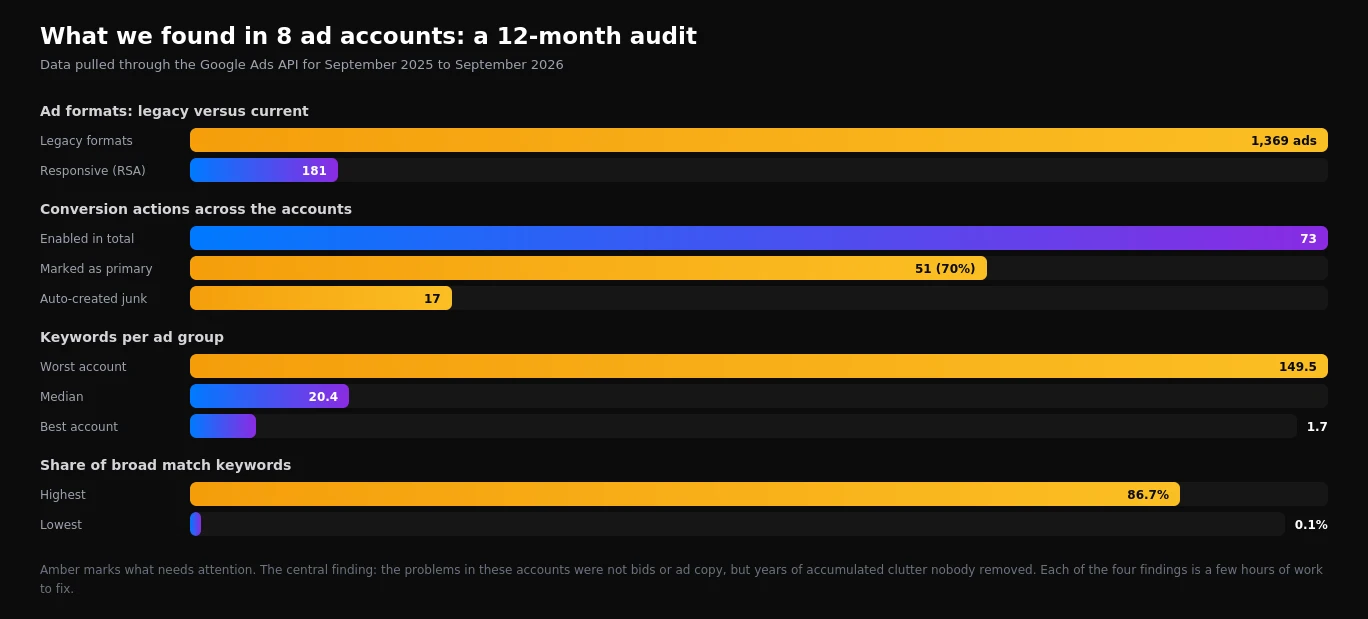
Across eight accounts we found no problems with bids or ad copy. We found something else: 1,369 dead ads in formats retired back in 2022; 51 conversion actions marked as primary, seventeen of which are auto-created junk; ad groups holding 149 keywords; and 87% broad match in an account with a thin negative keyword list. These are not configuration errors. They are the absence of housekeeping.
What we actually examined
So you can judge how much weight to give the conclusions, here is the method. We queried the Google Ads API and pulled five slices from each account:
- every enabled conversion action, with its type and primary status;
- every enabled campaign, with channel type, bidding strategy and network settings;
- negative keywords at campaign level;
- every enabled ad, with its format type;
- ad groups and keywords with match types.
The period runs from September 2025 to September 2026. The sample spans e-commerce, medical services, industrial products and B2B. In total: 63.5 million impressions, 1.11 million clicks and 23,434 recorded conversions.
We deliberately did not look at creative, landing pages or ad copy. Only structure, because structure is what nobody reviews for years.
Finding 1: 1,369 ads that physically cannot serve
Google retired expanded text ads in 2022, and plain text ads died earlier still. In five of the eight accounts, those formats are still sitting there marked as enabled.
The ratio came out at 1,369 ads in dead formats against 181 responsive search ads. Nearly eight defunct ads for every working one. In one account that means 958 text ads whose last impression was four years ago.
Dead ads spend nothing, which is why they are easy to ignore. But they do two unhelpful things. First, ad group statistics are calculated alongside them, so averages look worse than reality. Second, and more importantly: an account nobody has tidied in four years almost always carries the same four years of unfixed problems elsewhere. It is a marker rather than the disease itself.
Finding 2: 51 of 73 conversion actions marked as primary
This is the most expensive finding of the set. Conversion actions marked as primary are what automated bidding steers towards. With one or two, the algorithm knows what to optimise for. With ten, it optimises for whichever happens most often and costs least.
| What we found | How many | Why it is a problem |
|---|---|---|
| Enabled conversion actions in total | 73 across 8 accounts | An average of nine per account instead of two or three |
| Marked as primary | 51 (70%) | Bidding chases ten goals simultaneously |
| Auto-created app install actions | in 5 accounts | None of these businesses has a mobile app |
| Leftovers from Smart campaigns | in 4 accounts | Campaigns switched off long ago, actions still enabled |
The clearest example: in one account the primary conversions included clicks for driving directions and taps on the phone number in the business listing. Both happen far more often than a real enquiry and cost almost nothing. The algorithm dutifully steered towards them while the business wondered why enquiry volume was low despite excellent numbers in the report.
Finding 3: between 1.7 and 149.5 keywords per ad group
An 88-fold spread between accounts is not a difference in approach. It is the difference between work being done and work not being done.
The logic is simple: ad text should match the query. With five closely related keywords in a group, the headline can repeat them literally. With a hundred and forty-nine, the ad becomes generic by necessity, quality signals fall, and cost per click rises.
The median across the sample is 20.4 keywords per group, which is already the upper edge of sensible. Two of the eight accounts sit far beyond it, at 42.8 and 149.5.
Five to fifteen keywords per ad group for search campaigns. Above twenty, check whether the group can be split by intent. It usually turns out that three different intentions are living inside one group, needing three different ads and three different landing pages.
Finding 4: 86.7% broad match against a thin negative list
Broad match is not a mistake in itself. Combined with automated bidding and a thorough negative keyword list, it performs well. The problem appears when you have the first and not the second.
In the worst account in the sample, 8,008 of 9,235 keywords are on broad match while campaign-level negatives total 2,183. In the most disciplined account, broad match accounts for 0.1%, and the question never arises.
The spread in negative keyword counts is equally telling. One account holds 7,287 negatives against 39,000 clicks in a year. Another holds 169 against 532,000 clicks. That works out at 184 negatives per thousand clicks in the first case and 0.3 in the second.
Finding 5: accounts that spent for a year and recorded no conversions
Three of the eight accounts recorded zero conversions across twelve months. In two of them, conversion actions are configured and marked primary, meaning tracking exists on paper while recording nothing at all.
In practical terms: money went out, clicks came in, and the system received no signal about what any of it produced. Automated bidding operates blind under those conditions, and reporting shows cost per click in place of cost per customer.
Most often after a website update. A developer changes the form, the event stops firing, and nobody notices because nothing turns red in the interface. The second common cause is a consent banner configured so tags never fire before consent while no modelling is in place. The third is a conversion tied to a thank-you page that no longer exists.
What this means for your own account
All five findings share one property: none of them is about skill at campaign setup. They are consequences of an account running for years without review. Here is a check that takes about an hour.
- Open your list of conversion actions. How many are marked primary? More than two or three means you are optimising for everything at once. Demote anything that is not money.
- Find the auto-created actions. App installs, map clicks, leftovers from Smart campaigns you switched off a year ago. Disable them without sentiment.
- Sort your ads by type. Anything that is not a responsive search ad, shopping ad or video ad is archaeology. Remove it.
- Count keywords per ad group. Over twenty is a reason to split. Over fifty is a reason to rebuild the structure.
- Compare broad match against negatives. If more than half your keywords are broad and you hold fewer than a thousand negatives, you are paying for other people's searches.
- Submit a test enquiry. The simplest and most important check of all. If it does not appear in reporting within a day, nothing else on this list matters.
In our experience a full review of a mid-sized account runs four to eight hours. Conversion actions take longest, because each one has to be traced back to where it came from. The fastest payoff comes from pruning primary conversions: automated bidding starts seeing the right target within days.
What we deliberately did not measure
Honesty requires stating what this audit does not contain. We did not assess the quality of ad copy, landing pages or creative, because that is subjective and resists being reduced to figures. We did not calculate money lost to irrelevant queries, because that requires manually reading the search terms report for each account rather than an API export.
A sample of eight accounts makes no claim to statistical representativeness either. But eight is enough to see repetition: when the same problem appears in five accounts out of eight, it has stopped being a coincidence.
If reading this list made you want to check your own account and the hour is not available, we run this audit as a standalone piece of work with a written report and a prioritised list. Request a Google Ads audit and we will show you what is sitting in yours. If you would rather understand how an account should be built from the start, begin here: how to launch Google Ads from scratch.
Want results like this for your brand?
Get a free strategy call and a tailored proposal within one business day.
Get a Free Proposal