Sep 7, 2026
How Much Do Google Ads Cost in 2026? Full Pricing Breakdown

"How much do Google Ads cost" sounds like a question with one number as an answer. It has three, and mixing them up is the single most common reason a first advertising budget runs out weeks earlier than planned. There is the money Google takes for clicks. There is the one-time fee to build the campaigns. And there is the monthly fee to whoever manages them. Business owners usually ask about the first, agencies usually quote the third, and the total lands somewhere nobody planned for. Here is all three, with real 2026 numbers for the US and European markets.
$0.42
cross-industry average cost per click across a 13,000-campaign benchmark
$0+
realistic monthly floor for a campaign that gathers enough data to optimise
0-0%
of ad spend is the standard agency management fee range
0x
difference in click price between the cheapest and most expensive industries
For a small business in the US or Western Europe, budget $1,500 to $5,000 per month all-in: roughly $1,000 to $3,500 going to Google for clicks, plus $500 to $1,500 for management. Add a one-time setup fee of $500 to $2,500 to build the campaigns properly. In expensive verticals like legal, insurance or home services, a realistic starting point is $5,000 to $15,000 per month.
The three separate costs
Before any numbers make sense, separate the wallets. Google and your marketer are paid separately, for different things, and confusing them is how budgets blow up.
- The money charged for actual clicks on your ads
- You fund the account and spend this yourself
- Your agency never receives this money
- Fully under your control, changeable any day
- Daily bid, budget and audience decisions
- Search term review and negative keywords
- Ad testing and landing page feedback
- Reporting and strategy calls
- Keyword research and campaign structure
- Ad copywriting
- Conversion tracking configuration
- Analytics connection and testing
The classic mistake is budgeting only for column one. A business sets aside $2,000 "for advertising," then discovers that figure was only Google's share and the real monthly commitment is closer to $3,000. The opposite mistake is just as expensive: paying for a professional setup and then leaving the campaigns unmanaged, which reliably turns a well-built account into an expensive one within two months.
What a click actually costs in your industry
Google Ads has no price list. Every click is decided in an auction, and you are bidding against everyone else who wants the same person's attention. The more a customer is worth in your industry, the more everyone bids, and the more a click costs. That is why a personal injury lawyer and a coffee shop pay wildly different amounts for the exact same user action.
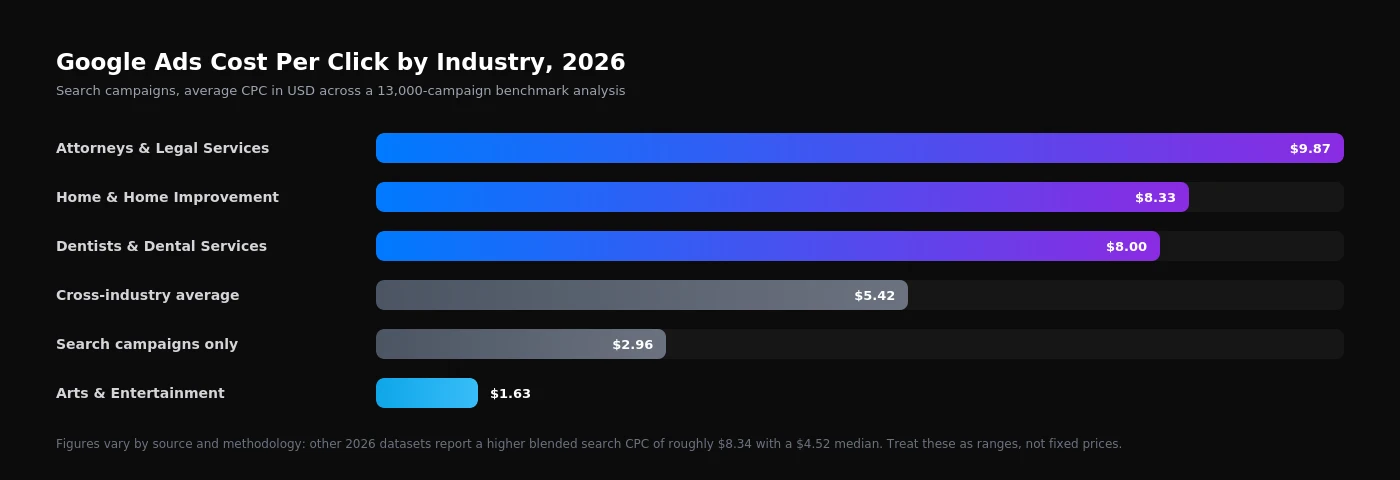
Worth noting that published figures vary by source and methodology. The benchmark above comes from an analysis of over 13,000 search campaigns, while other 2026 datasets put the blended search CPC closer to $8.34 with a $4.52 median, and report legal clicks reaching $22.75. In the most competitive corners of insurance and injury law, individual keywords are known to clear $100 per click. Treat every published CPC as a range, never as a quote.
If you serve one city or region, restrict your geographic targeting before you touch anything else. National campaigns force you to bid against national budgets for impressions you cannot service anyway. Tightening geography is the fastest, least technical way to lower your effective cost per click, and it is skipped constantly.
Minimum budget: what it takes to actually work
Google will happily let you deposit $50 and start. Practically, that teaches you nothing. Smart Bidding needs conversion data before it can find buyers rather than browsers, and a campaign starved of budget never reaches that point.
| Campaign type | Realistic monthly minimum | Why that number |
|---|---|---|
| Search, testing a niche | $1,000-$1,500 | Below this you get too few clicks to see which queries actually produce leads |
| Google Shopping | $1,000-$2,000 | Impressions spread across your whole catalogue, so volume matters more |
| Performance Max | $1,500-$3,000 | Needs a learning period plus existing conversion history to work from |
| Competitive vertical | $5,000+ | At $20 to $50 per click, smaller budgets buy only a few hundred visits |
There is a persistent fantasy about "testing with $300 and seeing what happens." In a niche with $15 clicks that is twenty visits. At a 3% conversion rate, that is zero or one lead. One lead tells you nothing at all: not whether the ads work, not whether the landing page converts, not whether the offer is right. The money is gone and no question has been answered.
How campaign types differ in price
Google Ads is not one product. The formats differ sharply in what a click costs and how long they take to produce a reliable result, and choosing the wrong one first is a common and costly error.
| Format | Typical CPC | Best for | Time to results |
|---|---|---|---|
| Search | $2-$50 | People actively searching for what you sell. Shortest path to a lead | 1-3 weeks |
| Shopping | $0.50-$3 | Retailers with a properly structured product feed | 2-4 weeks |
| Performance Max | $0.50-$5 | Accounts with existing conversion history and budget to learn | 4-8 weeks |
| Display | $0.20-$1 | Brand awareness and bringing past visitors back | Hard to measure directly |
| YouTube | $0.03-$0.30 per view | Products that need explaining, or building recognition | 1-3 months |
For most businesses the sequence is the same: start with Search. It costs more per click but answers the only question that matters at the beginning, which is whether demand exists and what a lead actually costs you. Display and Performance Max make sense once Search is working and you know your numbers.
Display deserves a specific warning because its $0.20 clicks look like a bargain next to $15 Search clicks. Someone who accidentally tapped a banner while reading the news and someone who typed "emergency plumber near me" are not comparable prospects. Comparing them on cost per click is meaningless. Compare on cost per lead and the picture usually reverses.
What agencies charge, and how
There are three common pricing models in the US and European markets. None is inherently better; they suit different budget sizes.
$500 to $5,000 per month
You pay the same amount regardless of how much you spend on clicks. This is the clearest model for small and mid-sized businesses: costs are predictable, and nobody has a financial reason to push your budget higher than it needs to be.
The weakness appears at scale. On very large accounts a flat fee eventually stops covering the work required, and the quality of management quietly declines as fewer hours get allocated to your account.
10% to 20% of ad spend
The standard model for larger budgets. Freelancers typically charge 10-15%, agencies 12-20%. On $20,000 of monthly spend that is $2,000 to $4,000 in management fees. In Europe the same structure holds, usually quoted as 10-20% or a €1,000-€4,000 monthly equivalent.
The obvious tension: your agency earns more when you spend more. That is workable, but only if you independently track cost per lead and hold the account to a target rather than to a spend figure.
Base fee plus performance component
A smaller retainer covers the baseline work, with a percentage or a bonus tied to results, such as keeping cost per acquisition under an agreed ceiling.
It is the fairest structure on paper and the most demanding in practice: it only works when conversion tracking is genuinely accurate. If the data is shaky, a performance bonus turns into an argument about whose numbers to believe.
If an agency is paid a percentage of spend and recommends increasing your budget without showing the maths behind it, that is a conflict of interest in plain sight. A legitimate recommendation to spend more always comes with numbers attached: current cost per lead, current lead volume, and what specifically is expected to change at the higher figure.
Three worked examples
Ranges are abstract, so here are three realistic situations with the arithmetic shown. Numbers are rounded, but the proportions reflect real accounts.
Example 1: Local dental practice, mid-sized US city
The practice advertises only in its own metro area. Dental clicks run around $8, and tight local targeting keeps it near that rather than higher.
- Ad spend: $2,000, buying roughly 250 clicks
- Landing page conversion: 6%, so about 15 enquiries
- Cost per enquiry: roughly $133
- Management: $900 flat
- Total monthly: $2,900
If the average new patient is worth $1,200 and one in three enquiries books, that is five patients and $6,000 in revenue. The channel is profitable, but the margin is not enormous, which means everything depends on how quickly the front desk answers.
Example 2: European e-commerce store, cosmetics
Selling across several EU countries using Shopping and Performance Max. Clicks average about €0.60.
- Ad spend: €3,000, roughly 5,000 clicks
- Conversion rate: 1.6%, about 80 orders
- Cost per order: roughly €37
- Management: 15% of spend, so €450
- Total monthly: €3,450
At an average order value of €65, revenue lands near €5,200. Margin decides everything here: below roughly 45% the campaign runs at break-even, and the fix is not a bigger budget but better repeat purchase economics and a higher average basket.
Example 3: Law firm, competitive US market
The most expensive scenario of the three. Clicks cost $25 even with city-level targeting.
- Ad spend: $8,000, roughly 320 clicks
- Conversion rate: 5%, about 16 enquiries
- Cost per enquiry: roughly $500
- Management: $2,000
- Total monthly: $10,000
That looks alarming until you price the client. If a single won case is worth $15,000, two clients out of sixteen enquiries clears the entire monthly cost three times over. In high-value verticals an expensive click is normal. What is not normal is failing to calculate what a client is ultimately worth before judging the click price.
What pushes the price up and down
Two companies in the same industry routinely pay twice different amounts per click. The gap almost always comes down to the following.
What makes it more expensive
- Broad keywords with no negatives. Your ad shows for "how to do it yourself" and "free," and you pay for clicks from people who were never going to buy.
- A weak landing page. Google scores page experience and charges more per click when it is poor. This is a direct multiplier on your bid.
- National targeting you do not need. You compete with big-city budgets for impressions in places you cannot serve.
- Round-the-clock scheduling. If nobody answers at 3am but the ads run, you pay for enquiries that go unhandled.
- No conversion tracking. Without data the algorithm optimises blind and buys traffic instead of customers.
What makes it cheaper
- Precise keyword intent. Buying-intent phrases cost more per click and less per lead.
- Weekly search term review. Adding negatives is the cheapest optimisation available and takes about thirty minutes.
- A fast, clear landing page. Lifting conversion from 2% to 4% halves your cost per lead without touching a single ad.
- Ad scheduling that matches business hours. Budget is spent when someone can actually respond.
- Properly configured conversions. The algorithm starts hunting for people who resemble your buyers rather than people who click.
This split is typical of accounts that run reliably month after month. If management and analytics together take less than a fifth of your total budget, the campaigns are probably running with minimal supervision.
What the setup fee actually buys
The one-time setup charge draws the most scepticism, because from the outside it is not obvious what you are paying for when "you can launch ads in ten minutes." You genuinely can. The problem is that such a campaign spends on random queries and gives you no way to see where enquiries came from.
- Competitive research. Who already advertises on your terms, what their ads and landing pages look like, roughly what they pay per click.
- Keyword research. Not a word list, but grouping by intent: ready to buy now, still comparing, just researching the topic.
- Negative keyword list. A solid starting list saves a meaningful share of first-month budget on its own.
- Campaign and ad group architecture. Tight thematic groups raise relevance, and relevance directly lowers your cost per click.
- Ad copywriting. Several headline and description variants per group so the system has something real to test.
- Conversion tracking. Forms, calls, chat messages, whatever counts as a result for you, all recorded properly.
- Analytics connection. GA4 and, where useful, Google Tag Manager, so you see behaviour and not just clicks.
- Technical checks. Page speed, mobile rendering, form functionality. Advertising into a broken form is the most expensive mistake available.
If a proposal for setup contains no mention of conversion tracking or analytics, ask directly why. A campaign without conversion tracking gives neither you nor the algorithm any feedback loop, which means you are paying for structure that cannot learn.
How seasonality moves the price
Click prices are not stable across the year. The auction responds to demand, and demand in most industries is cyclical, so the same keyword can swing 30-50% between months.
- November and December. Black Friday and the holiday run are peak season for anything retail. Bids climb because every advertiser enters the auction at once.
- August and September. Back-to-school pushes up prices in children's products, stationery and education services.
- Early spring. Construction, home improvement, gardening and travel all start their season, and rates rise with it.
The lesson is not to pause during expensive months. Clicks get expensive precisely because people are buying, and going dark in peak season hands it to competitors. The better approach is planning budget unevenly on purpose: more in peak months, less in the trough, instead of holding one flat figure all year and wondering why December produced fewer leads for the same money.
What to expect in month one versus month three
A common source of wasted money is not the budget itself but the timeline attached to it. Expecting month-three performance in week two leads people to shut down campaigns that were working, or to make panicked changes that reset the learning period and genuinely break them.
| Period | What is realistic | What to judge it on |
|---|---|---|
| Weeks 1-2 | First clicks and possibly first enquiries. Cost per lead is unstable and usually high | Whether tracking fires correctly and search terms look relevant. Not cost per lead |
| Weeks 3-6 | Wasteful queries have been excluded, bidding has data to work with, cost per lead begins settling | Direction of travel: is cost per lead trending down week over week |
| Months 2-3 | Predictable volume at a stable cost. This is your real baseline | Actual cost per lead and cost per customer against your margins |
| Month 4 onward | Scaling what works, testing new formats and audiences from a proven base | Total profit contribution, not channel metrics in isolation |
The practical rule: do not make structural judgements before you have accumulated at least thirty to fifty conversions. Below that number, the difference between a good week and a bad week is mostly randomness, and reacting to it does more damage than doing nothing.
Warning signs when hiring
- Guaranteed lead volume before auditing your account and site. Without knowing your conversion rate and your industry's click costs, that promise is invented.
- Refusing to give you ownership of the ad account. The account should be yours, with the agency granted access. Otherwise you lose all history when the relationship ends.
- Reports that only show clicks and impressions. If leads and cost per lead are missing, you are being billed for activity, not outcomes.
- Pricing far below market. Management at $150 a month buys an hour or two of attention. That is enough to keep campaigns running, not to make them work.
Frequently asked questions
How much do Google Ads cost per month?
For a small business in the US or Western Europe, $1,500 to $5,000 per month all-in is a realistic working range: roughly $1,000-$3,500 in ad spend plus $500-$1,500 in management. Competitive verticals like legal, insurance and home services realistically start at $5,000-$15,000 monthly.
Can I run Google Ads myself and skip the management fee?
Technically yes. In practice the first few months of self-management usually cost more than a specialist would have, because budget leaks into irrelevant queries while you learn the interface. Self-management makes sense when the niche is narrow, the geography is small and the budget is modest, so the cost of mistakes stays low.
What is the cheapest way to start?
Narrow geography, a small set of high-intent keywords, Search campaigns only, and conversion tracking configured before launch. That combination gets you usable data at the lowest possible spend, which is the actual goal of a first month.
Why does Google charge more than my daily budget?
Google can overspend the daily budget on high-demand days and compensates on slower ones. Across a full month you will not pay more than your average daily budget multiplied by the days in the month.
Is Google Ads cheaper than Facebook Ads?
Clicks on Meta are almost always cheaper, but intent is weaker: the person was scrolling, not searching. Google costs more per click and usually delivers a cheaper lead in categories where people actively look for a solution, such as professional services, repairs, healthcare and legal work.
Does Google Ads make sense on a $300 monthly budget?
In most industries, no, and it is more honest to say so. The exception is a narrow local service in a small market with sub-$2 clicks, where $300 still buys enough visits to learn something. Otherwise the money evaporates without producing a conclusion, and it is better either to save toward two or three properly funded months, or to use a channel with a lower entry cost.
My cost per lead went up and I changed nothing. Why?
Three usual suspects, in this order. A new competitor with a bigger budget entered your auction. Seasonal demand dropped while advertiser count stayed flat. Or something broke on your site, a form stopped submitting or the page slowed down, so clicks continued while leads stopped. Check them in that sequence.
Do I need a separate remarketing budget?
Yes, and it is one of the cheapest parts of any account. Showing ads to people who already visited costs a fraction of new acquisition, and conversion is higher because they know who you are. Most accounts allocate 10-20% of the budget to it, and in many niches that slice has the best return of anything running.
A competitor ranks above me even though I bid more. Why?
Position is not decided by money alone. Google calculates ad rank: your bid multiplied by expected click-through rate, ad relevance to the query and landing page quality. A competitor with a better page and sharper copy can sit above you while paying less per click. That is not a fault in the system, it is the incentive to improve the advertising rather than simply pay more for it.
Who should own the ad account?
You. Your agency gets access to your account, not the reverse. If campaigns live inside an agency-owned account, ending the relationship costs you the statistics, the configured conversions and the accumulated learning history, which is exactly what optimisation is built on.
The price of Google Ads is not a rate card. It is an equation where your industry, your geography and the quality of your landing page matter more than any agency's fee structure. If you want a realistic forecast for your specific market before you commit budget rather than after, our Google Ads team can model it from your niche and region. If campaigns are already running but the money is going somewhere you cannot explain, start with the self-run account audit, which takes about ninety minutes and surfaces most budget leaks.
Want results like this for your brand?
Get a free strategy call and a tailored proposal within one business day.
Get a Free Proposal