Sep 9, 2026
Dynamic Search Ads Move to AI Max in February 2027: Prepare This Autumn

In September, notices started appearing in ad accounts inviting advertisers to upgrade Dynamic Search Ads to AI Max. It reads like an optional recommendation, which is exactly why most people will dismiss it. In reality it is a warning about what happens automatically in February 2027: every legacy DSA campaign gets migrated whether you act or not, and creating new ones becomes impossible. The difference between a voluntary and a forced move is who controls the outcome.
0 mo
left before the automatic migration
0
AI Max features enabled by default on migration
0 days
the February migration wave will run
0
new DSA ad groups can be created afterwards
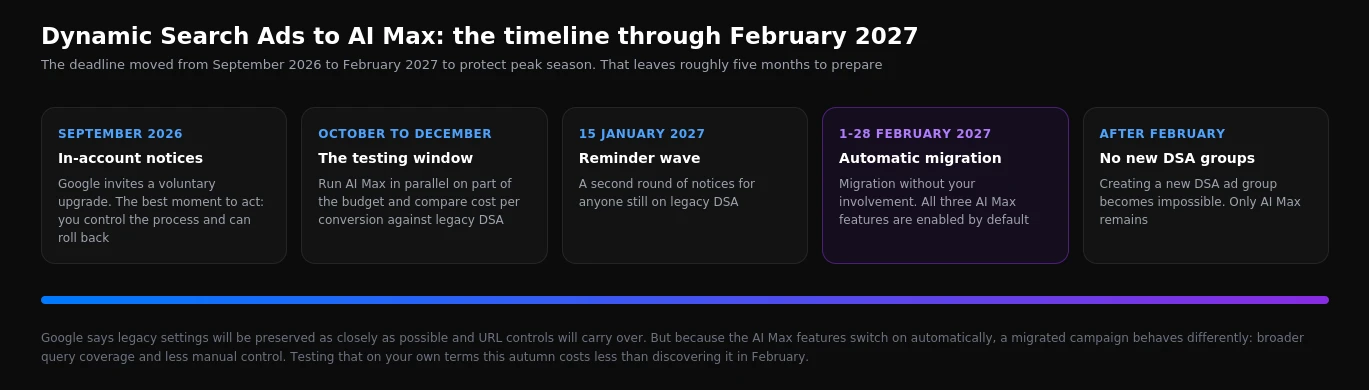
Google moved the automatic DSA to AI Max migration from September 2026 to 1-28 February 2027 to keep accounts stable through peak season. September brought notices inviting a voluntary upgrade, January brings a reminder. After February, creating a new DSA ad group becomes impossible. The sensible move is to test AI Max this autumn on part of the budget, while the cost of getting it wrong is low.
What AI Max is and how it differs from DSA
Dynamic Search Ads worked simply: Google crawled your site and generated queries and headlines from its content. You controlled which pages or categories were used, and that was where the control ended.
AI Max does the same thing more broadly. It is a set of features inside an ordinary search campaign combining automatic query matching, ad text generation and automatic landing page selection. Put plainly: where DSA worked from your website, AI Max also works from your existing keywords, expanding coverage beyond them.
| Dimension | Classic DSA | AI Max |
|---|---|---|
| Query source | Site content | Site plus expansion of existing keywords |
| Ad text | Headline generated, description yours | Generation of headlines and some descriptions |
| Landing pages | By your rules | Automatically selected, URL rules preserved |
| Reach | Bounded by site structure | Wider, including phrasings you never had |
| Control | Moderate | Lower, more decisions on the system's side |
Wider reach means more irrelevant queries at the start. An account whose negative list was built around narrow DSA logic will begin showing for phrasings it has never encountered. If the migration lands automatically in February and nobody reads the search terms report for two weeks, part of the budget disappears silently.
Why the deadline moved
The automatic migration was originally set for September 2026. After advertiser feedback Google pushed it to February, and the reason was stated plainly: avoid major account changes during the busy fourth quarter.
That is a rare case of the platform responding to complaints, and it is also a useful signal. If Google considers the change significant enough to keep away from peak season, treating it as cosmetic is unwise.
What to do this autumn
- Find every DSA campaign you have. In large accounts they often sit as separate ad groups inside ordinary search campaigns that nobody has looked at in months.
- Check how much they deliver. If DSA produces under 5% of account conversions, switching it off now is simpler than migrating and troubleshooting later.
- Refresh your negative keywords before the move. This is the key preparation step. Pull six months of search terms and add everything unrelated to your offer as a negative.
- Review which site pages are crawlable. AI Max, like DSA, works from your site. Outdated pages or empty categories should be excluded in advance.
- Upgrade voluntarily on one campaign. Not all of them at once. Take one mid-sized campaign and compare metrics over three or four weeks.
- Record your baseline before the switch. Cost per conversion, conversion volume, share of irrelevant queries. Without those numbers you cannot tell whether things got worse.
Upgrading voluntarily lets you pick the moment, test on one campaign and roll back if results drop. The automatic move in February arrives across every campaign at once, in the middle of a working quarter, and leaves you diagnosing after the fact. The difference is not AI Max itself but who controls the process.
How to test AI Max in three weeks
A test is only useful if you know in advance what you are comparing. Here is a structure that produces an answer without putting the account at risk.
| Stage | What to do | What to watch |
|---|---|---|
| Preparation | Record 60 days of current DSA metrics, refresh negatives | Cost per conversion, volume, share of irrelevant queries |
| Week 1 | Upgrade one campaign to AI Max and change nothing else | The search terms report, daily, and nothing else |
| Week 2 | Add negatives from the new queries, leave bids alone | Whether cost per conversion is stabilising |
| Week 3 | Compare against the baseline | The decision: migrate the rest or wait for February |
One important detail: do not change bids, budgets or ad copy at the same time. If several variables move during a test, you will not know what produced the result and the conclusion will be accidental.
In the first week after upgrading, cost per conversion typically rises 20-40% while the system explores new queries. If it returns to the previous level or below by the end of week three, the migration worked. If it is still 30% higher, the cause is almost always the negative keyword list rather than AI Max itself.
What is preserved and what changes
Google states that on automatic migration existing settings are preserved as closely as possible and URL controls carry over. That covers the technical side. What changes is behaviour.
- Reach expands. The campaign starts appearing for queries that existed neither in your keywords nor in your site structure.
- More text gets generated. If you have strict rules about wording, verify that on a test campaign rather than assuming.
- Reporting gets coarser. Some of the system's decisions do not break down into the familiar components that classic DSA offered.
- All three features switch on automatically. They can be disabled individually afterwards, but only if you know what to look for.
Who should move first
- Online stores with large catalogues. DSA usually drives the most traffic here, and the change in reach is felt most sharply.
- Categories with sensitive wording. Healthcare, finance, legal: automated text generation here needs verification, not hope.
- Accounts with stale negative keyword lists. If nobody has touched them in a year, the migration will expose that immediately.
- Anyone where DSA is the main conversion source. The risk is highest, so the testing should start earliest.
Frequently asked questions
Can I simply not migrate?
No. After the February wave, new DSA ad groups cannot be created and existing ones are moved automatically. The only choice is when and on what terms.
Can I roll back after migrating?
With a voluntary upgrade you have time to compare results and decide while the old format still exists. After February there is no route back to classic DSA.
Is AI Max more expensive than DSA?
Not inherently. What makes it more expensive is expanded reach against a stale negative list: the system enters new queries, some of which do not convert. In a prepared account, cost per conversion usually holds steady.
Is this the same as the September broad match migration?
No, they are separate processes. September 2026 covered campaign-level broad match and legacy automatically created assets. The DSA migration is its own track with its own deadline.
What if DSA outperforms our regular campaigns?
All the more reason to move early and calmly rather than in February. If the format is central to your account, a botched automatic migration will cost you more than anyone.
February is five months out, which is precisely why this will be forgotten until January. But September is the only window where the change can be tested on your own terms without seasonal pressure. If you want us to review your DSA campaigns and run the transition in a controlled way, talk to our team. If you would rather understand how a search campaign should be built in the first place, start here: how to launch Google Ads from scratch.
Want results like this for your brand?
Get a free strategy call and a tailored proposal within one business day.
Get a Free Proposal