Sep 16, 2026
Google Ads Ad Schedule: Why Someone Else's Best Hours Can Hurt Your Account

"Switch ads off at night." "Weekend conversions cost more." "People buy better in the evening." These tips get passed from article to article, and each sounds convincing. We tested them against data from the accounts we audited: twelve months, with spend and conversions broken down by day of week and hour of day.
It turned out that each tip is true for one account and harmful for another. And one of them rests entirely on a statistical illusion that disappears the moment you look at accounts separately.
0%
of spend falls on weekends in every account
0.1x
more expensive weekend conversions in one account
-0%
"cheaper evenings" that no single account actually shows
0.6%
of conversions at night on 18.7% of spend in one account
In every account in the sample, weekends take 27-28% of spend, which is exactly the share of the week that Saturday and Sunday represent: nobody set an ad schedule. The results differ widely, though: in one account a weekend conversion is 12% cheaper than on weekdays, in another it costs three times as much. Pool the accounts together and evenings look 16% cheaper than average, yet no individual account shows that: this is Simpson's paradox. Night-time in one healthcare account brings 1.6% of conversions on 18.7% of spend, while in another it brings 19% of conversions. The conclusion: an ad schedule can only be set from your own account's data, and with an eye on what actually counts as a conversion.
How we counted
We used the accounts where conversions are recorded correctly: two online stores and two healthcare accounts. The period covers twelve months. Spend and conversions are broken down by day of week and hour of day in the account time zone, across all campaign types combined.
Cost per conversion in each segment is shown as an index against that same account's average cost per conversion: 100 is average, below 100 is cheaper, above is more expensive. That allows comparison across accounts with different industries and budgets.
One technical point matters for everything below: Google Ads assigns a conversion to the time of the click, not the time of the conversion itself. If someone clicked at 2 am and phoned at 9 am, that conversion belongs to the night-time hour.
Weekends: the same spend, different results
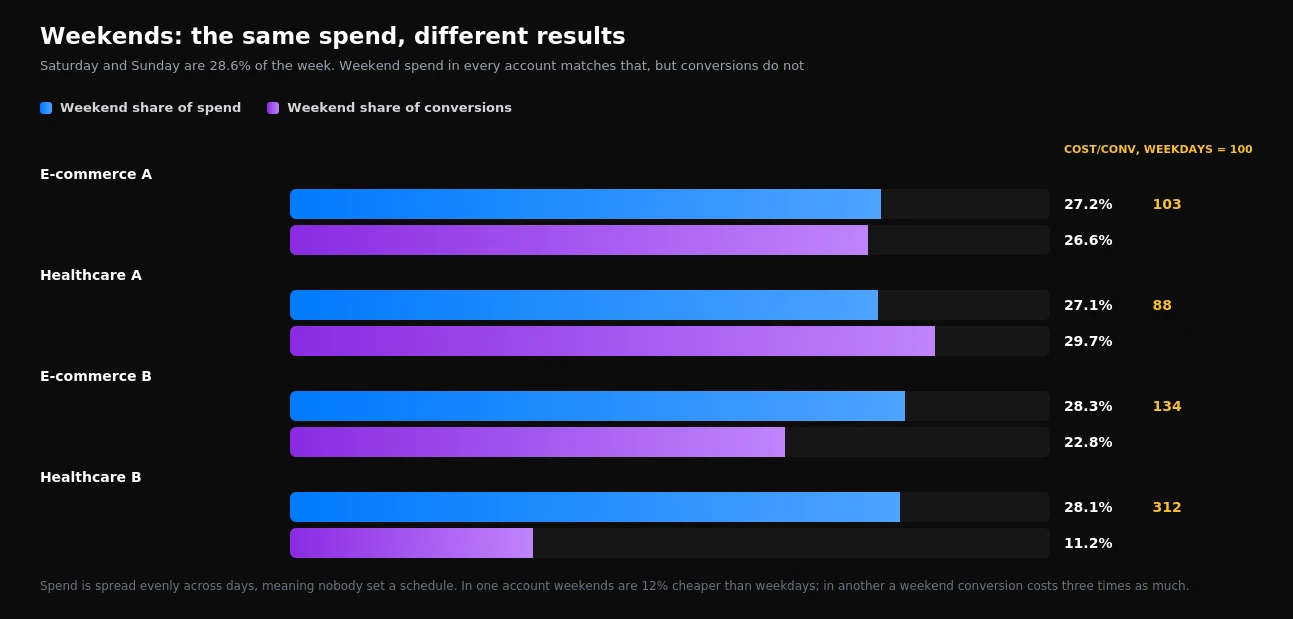
| Account | Weekend spend | Weekend conversions | Weekend cost/conv, weekdays = 100 |
|---|---|---|---|
| E-commerce A | 27.2% | 26.6% | 103 |
| Healthcare A | 27.1% | 29.7% | 88 |
| E-commerce B | 28.3% | 22.8% | 134 |
| Healthcare B | 28.1% | 11.2% | 312 |
Saturday and Sunday make up 28.6% of the week. The weekend share of spend in all four accounts is almost exactly that. In other words, budget is distributed evenly across days, and nobody decided whether ads should run at the same intensity at weekends.
The results, however, diverge sharply. In the first store weekends are practically no different from weekdays. In Healthcare A weekends are actually 12% cheaper. In the second store a weekend conversion costs a third more. And in Healthcare B it costs three times as much.
Look at Healthcare B day by day and the picture becomes starker still.
| Day | Mon | Tue | Wed | Thu | Fri | Sat | Sun |
|---|---|---|---|---|---|---|---|
| Healthcare B, average = 100 | 77 | 91 | 62 | 80 | 96 | 180 | 423 |
| E-commerce B, average = 100 | 93 | 88 | 88 | 97 | 100 | 122 | 127 |
| Healthcare A, average = 100 | 103 | 115 | 102 | 93 | 106 | 86 | 96 |
Sunday in Healthcare B costs four times the average day, while Wednesday is 38% cheaper. Around 14% of this account's annual budget goes on Sundays.
Evenings and Simpson's paradox
Now the most interesting part. Pool all four accounts together and look at cost per conversion by time of day, and the evening from 18:00 to 23:59 looks like the best buy: 16% cheaper than average. The typical conclusion is to raise evening bids.
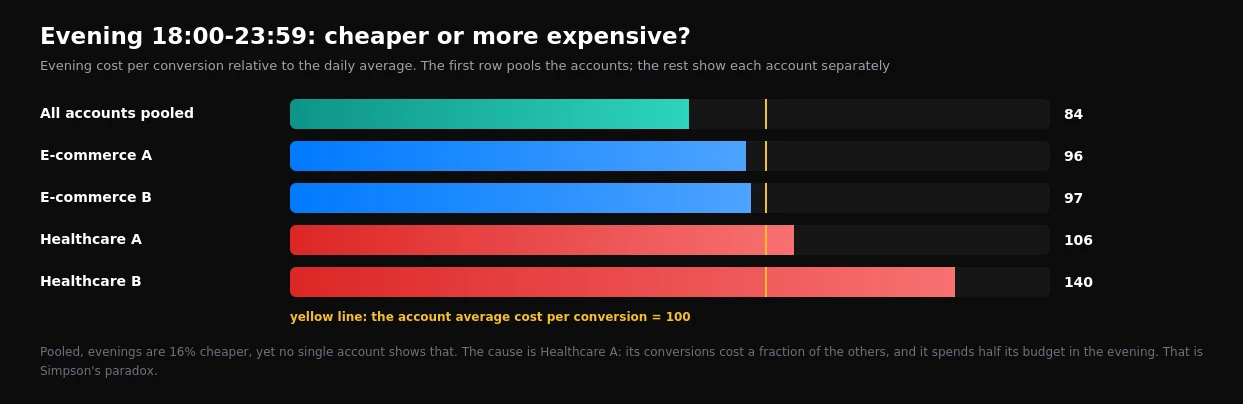
But split the same data by account and the "cheap evening" disappears. In both stores evenings are only 3-4% cheaper than average, which is practically no difference. In Healthcare A evenings are 6% more expensive. In Healthcare B they are 40% more expensive. No individual account shows what their sum shows.
This is classic Simpson's paradox: a trend present in pooled data disappears or reverses within each separate group. The cause is the composition of the sample. Healthcare A gets conversions several times more cheaply than the others: it accounts for only 2.5% of combined spend but 16.5% of all conversions. And it spends half its budget in the evening. So in the pooled data, evenings are packed with one account's cheap conversions. Healthcare B, by contrast, is expensive and spends only 13% of its budget in the evening.
The same illusion applies to mornings. Pooled, 7:00 to 11:59 looks 14% more expensive than average, yet no individual account shows mornings more than 4% above average.
Most advice about "best hours" comes from exactly this kind of pooled data: benchmarks, platform reports, agency generalisations across all clients. They describe an average in which one large or unusually cheap account decides the result for everyone. Applying those conclusions to your own account without checking means tuning it to someone else's data.
Night-time: one tip, two opposite outcomes
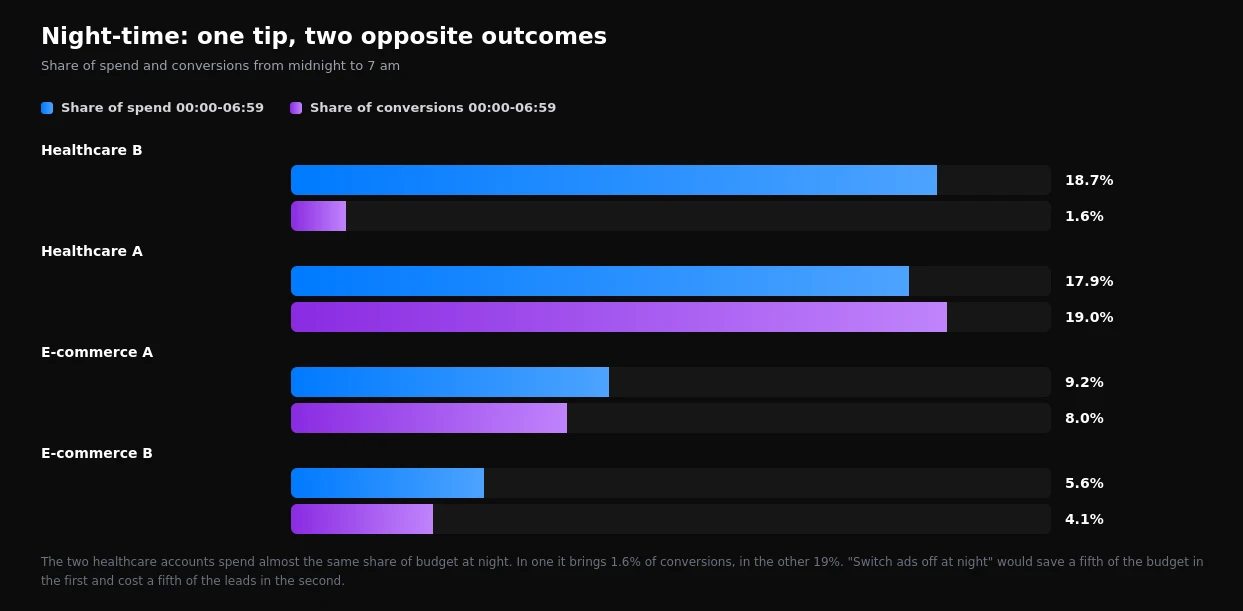
"Switch your ads off at night" is the most popular tip of all. Our data shows why it cannot be applied blindly.
In Healthcare B, 18.7% of budget is spent between midnight and 6:59, and those hours bring 1.6% of conversions. A night-time conversion costs 11.5 times the average. For this account, night-time serving is a fifth of the budget with almost nothing to show for it.
In Healthcare A, almost the same share of budget goes on night-time, 17.9%, but it brings 19% of conversions. A night-time conversion here is even slightly cheaper than average. Switching off night-time serving in this account would mean losing a fifth of its leads.
The difference comes down to what counts as a conversion. In Healthcare B the conversion is a phone call. The clinic is closed at night, and someone who clicks an ad at 2 am often never calls. In Healthcare A the conversion is a callback request through a website widget, which can be left at any hour. Same industry, same human behaviour, opposite conclusion, because the conversion mechanism differs.
Important: automated bidding ignores time-based bid adjustments
Before changing a schedule, it is worth knowing how it interacts with automated bidding. If a campaign runs on target CPA, target ROAS or maximise conversions, day and hour bid adjustments are not applied. The algorithm already treats time of day as a signal in each auction.
Only the schedule itself still counts, meaning the decision to show ads at certain times or not at all. So under automated bidding the choice is binary: keep an hour or a day in the schedule, or remove it. There is no in-between "a bit less in the evening", as we explained in more detail in our device analysis.
One more nuance: automated bidding partly solves the problem on its own by lowering bids in hours with few conversions. The fact that Healthcare B still spends a fifth of its budget at night suggests the algorithm does not see the difference, most likely because it has too few conversions to learn from.
How to analyse your own account's schedule
- Use at least 6-12 months of data. Over shorter periods, night-time hours and individual days have too few conversions to conclude anything.
- Calculate an index. Cost per conversion in the segment divided by the account's average cost per conversion. Do not compare against benchmarks or other accounts.
- Group the hours. Individual hours are noisy. Use blocks: night, morning, daytime, evening.
- Check the volume. If a segment has fewer than 30 conversions in the period, the difference may be random.
- Account for the conversion type. Calls depend on opening hours; forms and purchases do not.
- Look at campaign types separately. Search and Performance Max can behave differently at the same times.
- Make binary decisions. Under automated bidding, remove hours from the schedule only where cost per conversion is consistently several times higher, not 10-20% higher.
| What you see | What it usually means | What to do |
|---|---|---|
| Nights or weekends several times more expensive, conversion is a call | Nobody is there to take the call | Remove from the schedule, or offer out-of-hours enquiries |
| Nights cheaper than average, conversion is a form or widget | People leave enquiries when it suits them | Keep, and check night-time lead quality in the CRM |
| A 10-20% difference either way | Noise or a weak effect | Change nothing |
| Advice from a benchmark or someone else's experience | Possibly a pooled-data illusion | Test it on your own account |
What this data does not prove
Four accounts are an illustration, not statistics, and we do not present these indices as industry norms. "Weekends cost three times as much" applies to one account and does not mean every clinic will see the same.
The data combines all campaign types, so some of the difference between hours may reflect different campaigns running at different times. We also cannot see lead quality: night-time enquiries in Healthcare A may turn out weaker in the CRM, which would change the night-time conclusion for that account.
Finally, the conversion in Healthcare A is a widget request, and in our Performance Max analysis we already saw a jump in these "leads" in this account whose quality is questionable. So we would also recommend checking the cheap-night conclusion for it against the CRM.
This is part of a series of analyses based on our audit data. If you want us to review the schedule, devices and other segments in your account using your own data, start with a one-day Google Ads, GA4 and GTM audit. And if calls and leads are not counted accurately, set up conversion tracking first, otherwise any schedule analysis will rest on the wrong numbers.
Want results like this for your brand?
Get a free strategy call and a tailored proposal within one business day.
Get a Free Proposal