Sep 7, 2026
Google Ads vs Facebook Ads in 2026: Which Channel to Choose

Almost everyone planning a first advertising budget asks which is better, Google or Facebook. The honest answer sounds boring: they are different tools for different jobs, and comparing them directly makes about as much sense as comparing a hammer to a screwdriver. But behind that boring answer sits a specific decision logic, and it can be explained with numbers. Here is which channel wins in which situation, what a lead actually costs in each, and how to split a budget when there is only enough for one.
$0.42
average Google Ads cost per click across industries
$0.72
average Meta cost per click, roughly a third of Google's
0/0
common split favouring Google when leads are needed immediately
0 sec
how long Meta creative has to stop someone scrolling
If people already search for what you sell, start with Google Ads: clicks cost more, but leads are usually cheaper because intent already exists. If nobody knows your product yet, or it sells visually, start with Meta: clicks are cheaper but the path to purchase is longer. The strongest setup for most businesses is both, with Google capturing existing demand and Meta creating new demand.
The one difference everything else follows from
The gap between these channels is not technology or audience size. It is the state the person is in at the moment your ad appears.
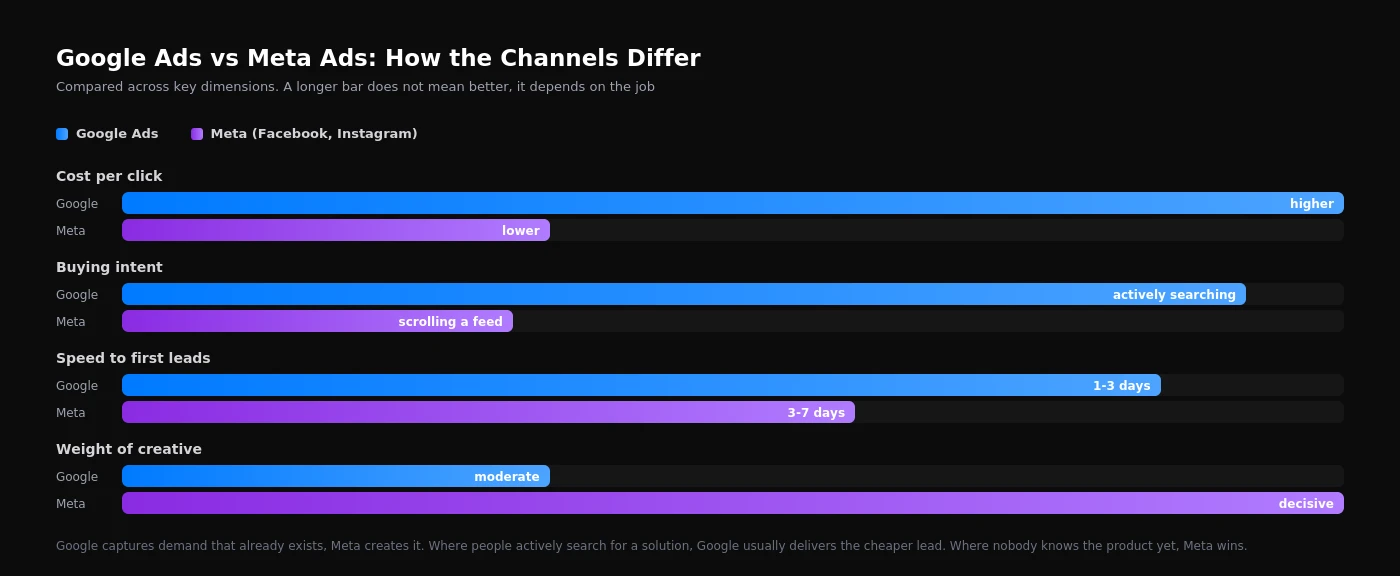
On Google, the person typed the query themselves. They have recognised a problem, put it into words, and are looking for a solution. Your job is simply to appear in front of them and not scare them off. On Meta, the person was scrolling through photos of friends and your ad interrupted that. They were not searching and not planning. You first have to earn attention, then explain why this matters to them, and only then talk about buying.
Every practical difference follows from this. On Google the priority is picking the right queries and not paying for irrelevant clicks. On Meta the priority is creative that stops a thumb mid-scroll. Which is why a video production budget is mandatory on Meta and can be nearly zero on Google.
When to choose Google Ads
- Urgent demand. A burst pipe, a broken fridge, a car that will not start. Nobody scrolls a feed waiting for a plumber's ad to appear; they open search.
- People know what they want. A specific model, a specific service, a specific part number. Demand exists and simply needs capturing.
- Complex or high-value services. Legal, medical, construction. These decisions are made deliberately, and deliberation starts with a search.
- Narrow B2B. When your total addressable market is a few thousand companies, interest-based targeting barely functions, while a search query lands precisely.
- You need leads this week. Google produces results faster: a campaign can generate enquiries on launch day.
When to choose Meta
- A product people do not know exists. If nobody searches for it because they have never heard of it, search will never find you. Demand has to be created.
- Visual categories. Clothing, jewellery, cosmetics, furniture, interiors, food. Images and video sell these better than any search text.
- Impulse purchases. An affordable product that is pleasant to buy spontaneously performs well in a feed.
- Broad audiences with no defined query. When almost anyone could buy but no one phrases a search for it.
- Small budget in an expensive category. If a Google click costs $25 and you have $800 a month, Meta will buy far more audience contact for the same money.
Side by side on the specifics
| Dimension | Google Ads | Meta Ads |
|---|---|---|
| Average cost per click | $5.42 | $1.72 |
| Realistic monthly minimum | $1,000+ | $750+ |
| First leads | 1-3 days | 3-7 days |
| Time to stable performance | 2-4 weeks | 2-3 weeks |
| Creative cost | Minimal, mostly text | Mandatory and recurring |
| Fatigue rate | Slow, ads last months | Fast, creative burns out in 3-6 weeks |
| Lead quality | Higher, the person searched | Lower, requires qualification |
| Scalability | Capped by search volume | Near-unlimited while audience remains |
This is the row people most often skip, and it matters most. A Meta instant-form lead is cheaper but closes worse: nothing was troubling that person, they simply saw an appealing offer. A search lead costs more but was actively looking for a solution. When comparing channels, compare cost per actual customer, not cost per lead.
How targeting works in each
Both systems solve the same problem, finding someone who will buy, but they approach it from opposite ends.
Google starts from the query
The foundation is the words someone typed. You choose which queries to appear for and add negatives to filter out the rest. Additional layers follow: geography, schedule, device, audiences as observation. But the base is always search intent.
This gives predictability. You roughly know who will see your ad before launching. The downside is a hard ceiling: if your term is searched 500 times a month, you cannot appear more than 500 times regardless of budget.
Meta starts from the person
The system knows a great deal about users: age, location, interests, app behaviour, purchase history from connected stores. You can describe an audience manually, but current best practice is the opposite: give it a broad audience and strong creative, and let the algorithm find who responds.
That buys scale and costs control. You will not always understand why the ad reached particular people, and you cannot constrain delivery as precisely as on Google.
On Google you control who sees you through words. On Meta you control it through creative. A video made for a young audience will attract a young audience even with a wide age range set, because the algorithm reads response and adapts. This is why changing creative on Meta usually outperforms changing targeting settings.
The same business, costed in both channels
Take a dental practice in a mid-sized city with $1,500 a month and run the numbers both ways.
$1,500 into search
Dental clicks with tight local targeting run about $8, giving roughly 190 clicks. A 5% site conversion produces about 9 enquiries at $158 each. If 40% book, that is 4 patients at roughly $375 acquisition cost.
These people had a concrete problem: a painful tooth, a needed implant, a search for a nearby clinic. Show-up rates are high and the call with reception is short.
$1,500 into Meta
Clicks cost about $1.70, giving roughly 880 visits. Conversion is lower, around 2.5%, because nobody was looking for a dentist. That yields 22 leads at $68 each, far cheaper than Google. But only about 20% attend, giving 4 patients at roughly $340 each.
Cheaper lead, similar patient cost. This is the classic case where comparing cost per lead misleads completely.
$1,000 Google plus $500 Meta
Google captures the urgent demand while Meta runs retargeting: showing ads to people who visited the site and reminding them the clinic exists.
The combined result usually beats the sum of its parts, because Meta retargeting lifts conversion among people who arrived from search and did not book immediately. This is why the combination nearly always outperforms a single channel.
These figures are broadly US-based. In Western Europe both channels sit somewhat lower: Google clicks average around €3.80 and Meta around €1.20, with the same ratio between them holding almost everywhere. The relative logic of the two channels does not change with the currency; only the absolute numbers do.
How to split the budget
There is no universal ratio, but there are working starting points depending on the job.
| Situation | Meta | Reasoning | |
|---|---|---|---|
| Leads needed immediately | 70% | 30% | Capture existing demand now, Meta handles retargeting |
| New product, no demand yet | 20% | 80% | You have to explain why anyone needs it first |
| Fashion e-commerce | 40% | 60% | Visual category, but branded search still converts |
| Complex B2B service | 80% | 20% | Narrow audience, precise search intent |
| Local business | 50% | 50% | Search plus neighbourhood awareness in the feed |
If you can only afford one
This is the real situation for most small businesses, and there is a simple test. Open Google and type the query a customer would use. If competitor ads already appear, demand exists and Google is the place to start. If there are no ads at all, that means either no demand or an unexploited niche.
The second check is Google's Keyword Planner. It is free and shows how often a term is searched monthly. A few dozen searches means search will not sustain you and Meta is where demand must be created. Thousands of searches means start with search.
If your product solves a problem the customer knows about and can describe in words, that is Google. If your product improves life in a way they have not thought about yet, that is Meta. Dentistry, repairs, legal help: Google. Designer jewellery, hobby courses, homeware: Meta.
Time and attention each channel demands
Comparisons rarely mention this, though for a small business it often decides the outcome. The channels require different kinds of work at different rhythms.
| What it requires | Google Ads | Meta Ads |
|---|---|---|
| Weekly routine | Reviewing search terms, adding negatives | Checking frequency and creative fatigue |
| Asset production | A few text variants every few months | 2-4 new creatives monthly or performance decays |
| Skills needed | Analytical: data, keywords, bidding | Creative plus analytical: video ideas and result reading |
| Time to manage | 2-4 hours weekly | 4-8 hours weekly including creative |
| What usually breaks | Irrelevant queries eat the budget | Creative burns out and cost per lead climbs |
The practical conclusion: if nobody on your team can regularly produce video, or at least film work on a phone, Meta will be harder than it looks at the planning stage. Conversely, if nobody will dig through reports weekly, Google slowly turns into a channel that spends budget on accidental queries.
Three real-world scenarios
Phone repair shop
Demand is urgent and fully formed: someone cracked a screen and is looking for a repair nearby right now. They will not scroll a feed waiting. Google takes almost the entire budget, with Meta serving only local awareness. Roughly 85/15, and even that 15% works better as retargeting than acquisition.
The common mistake here is investing in polished Instagram video that a person with a broken screen will never see at the moment they need it.
Handmade ceramics brand
The opposite case. Nobody searches for "handmade mug with uneven rim" because they do not know they want one. But seeing it in a feed, they might fall for it instantly. Meta takes about 80%, while Google handles branded search once someone has heard of the brand and looks it up by name.
A branded search campaign costs very little here and almost always pays for itself: you simply avoid handing your own traffic to competitors bidding on your name.
Programming courses
The hardest case, because both mechanisms operate at once. Some people have already decided to change careers and search "Python course for beginners", which is Google. Others have never considered it, but will see a graduate's story and start thinking, which is Meta.
The split lands near 50/50, and this is where the compounding effect is clearest: someone sees a video on Instagram, searches the school by name a week later, arrives from search and buys. Formally that is a Google sale; in reality Meta created it. Without cross-channel analysis you will conclude Instagram does not work.
How to compare the channels in your own business
General guidance points the way, but only your own numbers give the answer, and getting them right means measuring something other than what the ad platforms show.
- Measure cost per customer, not per lead. Take actual paid orders per channel over a quarter and divide spend by them. That is the only figure worth comparing honestly.
- Ask customers where they came from. One field in the form or one question from a salesperson yields more truth than any analytics setup, especially with long decision cycles.
- Look at assisted conversions. GA4 reports show which channels participated in the journey even when the last click happened elsewhere. Meta frequently turns out to be exactly that channel.
- Compare like periods. A launch month always underperforms later ones while algorithms learn. Comparing Meta's first month with Google's third is a standard error.
- Account for repeat purchases. A channel bringing one-time buyers is worse than one whose customers return, even if the first purchase cost more.
Both ad platforms count conversions by their own rules and both claim credit for the same sales. Add Google Ads and Meta conversions together and the total will almost always exceed your real order count. That is not fraud, it is different attribution models. Trust your CRM or order system for the headline number and use the ad platforms for optimisation within each channel.
What actually drives results in each channel
When a campaign stops producing enquiries, most people start adjusting bids and swapping audiences. In reality the weight of each factor differs sharply between the two channels, and the easiest way to show that is in percentages. Below is the approximate contribution of each element to the final result, based on how campaigns behave in practice.
Google Ads: words and the landing page decide it
The takeaway for Google: if you are not reading the search terms report weekly, you are working blind on the single most important part of the system. Rewriting headlines produces the smallest lift, yet it is where most people spend the most time.
Meta: creative decides it
Meta is the mirror image. You can spend a week cycling through interest targets without moving cost per lead at all, then halve it in two days with one new video. So when someone says Facebook does not work for their business, the first question is how many distinct creatives they have tested. If the answer is two or three, the channel has not actually been tested yet.
Google underperforming? Look at which terms you are showing for and where those people land. Meta underperforming? Shoot new video. Nine times in ten the problem sits there rather than in account settings.
Which channel to add second, and when
Assume the first channel is already producing steady enquiries. The question of when to add the second one has fairly concrete answers.
- When the first channel hits its ceiling. For Google that is the point where you already appear for every relevant query and extra budget buys more expensive clicks rather than more leads.
- When cost per customer starts climbing. That is a normal signal of audience exhaustion inside the channel, not a reason to simply raise bids.
- When you have $500-700 monthly specifically for the new channel. Taking money away from a working channel to test a new one is the most common mistake; both end up underperforming.
- When someone can produce creative. This applies specifically to Meta: without a regular supply of video the channel will not get going, however healthy the budget.
The second channel almost always looks worse than the first at the start. That does not mean it fails: the first one has already finished learning, accumulated conversion data and been refined over months. Give a new channel at least six weeks before drawing conclusions.
What changed in 2026
Both platforms moved in the same direction over the past two years, and it changes how the comparison plays out.
- Manual control shrank on both sides. Google pushes broad match with Smart Bidding; Meta pushes Advantage+ with broad audiences. The lever that matters now is the input: your queries, your offer, your creative.
- Conversion data became the real currency. Whichever channel receives cleaner signals about actual sales optimises better. Server-side tracking is no longer an advanced extra.
- Video spread into search too. Google's visual surfaces mean assets produced for Meta increasingly get reused inside Performance Max, which lowers the practical cost of running both.
- Attribution got murkier, not clearer. Privacy changes mean neither platform sees the full journey, which is exactly why your own CRM numbers now matter more than either dashboard.
Common mistakes when choosing
- Comparing channels on cost per click. Meta clicks are always cheaper and that tells you nothing about the real cost of a customer.
- Launching both on a tiny budget. Splitting $800 in half gives neither algorithm enough data. Better to learn one properly first.
- Reusing creative across channels. Search ad copy does not work as a video caption, and a Reels video has nowhere to appear in search.
- Judging Meta on first-visit conversions. People see an ad, remember you a week later, and arrive via a branded search. Formally that is a Google conversion; Meta created it.
- Treating one channel as replacing the other. They are not competitors. Meta retargeting on search visitors is among the cheapest conversions available anywhere.
How they reinforce each other
- Meta creates demand, Google captures it. Someone watches a video, becomes interested, does not act. Days later they search your brand name and your branded campaign meets them, at a fraction of the usual click cost.
- Google supplies data, Meta uses it. Search term reports show which phrasings generate leads, and those phrasings become the messaging in Meta creative.
- Meta retargeting on Google traffic. A search visitor left without converting. They see a reminder in the feed. This is the cheapest conversion in either channel.
- Customer lists work in both. The same purchaser file loads into Google and Meta: in one to exclude existing buyers, in the other to find lookalikes.
Frequently asked questions
Which is cheaper, Google Ads or Facebook Ads?
Meta clicks are almost always cheaper, often by a factor of three. But cost per actual customer is frequently lower on Google, because the person was already looking. Compare cost per sale, not cost per click.
Where should I start if I have never advertised?
Check whether people search for your product using the free Keyword Planner. If they do, start with Google, where predictable results come faster. If they do not, start with Meta.
Can I run both channels myself?
One, yes, especially in a narrow niche. Both simultaneously is hard: different logic, different interfaces, different optimisation principles. Most people learn one thoroughly before adding the second.
What is the minimum for running both?
Realistically $2,000-$2,500 monthly including management. Anything smaller, split in half, denies both algorithms the data they need to learn.
Why are Meta leads cheaper but sales fewer?
Because instant forms are too easy to submit: two taps with details pre-filled. Someone can do it out of curiosity. On Google the person searched deliberately, visited the site and filled a form manually, which reflects a different level of intent.
Do I need a separate site for Meta?
Not a separate site, but often a separate landing page. Meta traffic is colder, so the page must establish value before asking for action. A page that converts well from search frequently underperforms with feed traffic.
Should I try TikTok instead of Meta?
It is a separate channel with its own logic rather than a replacement. TikTok usually delivers cheaper reach among younger audiences but demands even more specific creative: even videos that perform in Reels often fail there. The sensible sequence is to make Google or Meta work reliably first, then test a third platform, rather than spreading a budget across three at once.
Which scales better?
Meta. On Google you are capped by how many people physically search your terms; more money does not create more demand. Meta's audience is effectively unlimited, so budget increases keep producing growth for longer.
The choice between channels is not about which is better, but about what state your customer is in when they meet your advertising. If you want to know where to start in your specific market and see a forecast for both channels before committing, talk to our paid media team. If you would rather work through the numbers yourself first, start with the cost breakdowns: what Google Ads costs and what Meta advertising costs.
Want results like this for your brand?
Get a free strategy call and a tailored proposal within one business day.
Get a Free Proposal