Sep 8, 2026
SEO vs PPC in 2026: Which Delivers Cheaper Customers

Almost everyone planning a first growth budget asks the same thing: invest in SEO or run ads. The two answers people usually get are equally useless - "it depends on your business" and "do both". This is different: real numbers, real payback periods and clear criteria you can apply to your own project today.
0-3 days
to the first leads from paid search
0-6 mo
to the first meaningful results from SEO
0%
of website traffic comes from organic search
$0
cost of an organic click once the page ranks
If you need leads this week, run paid search. If you are planning a business over years and want cost per lead to fall rather than rise, invest in SEO. Beyond twelve months SEO is almost always cheaper per customer, but it runs at a loss for the first six. Which is why the standard pattern is this: ads feed the business now, SEO builds its future.
The core difference: renting traffic or building an asset
Paid search is rent. You pay per click and receive traffic for exactly as long as you pay. Switch the budget off on Monday and by Tuesday there are no enquiries. Nothing compounds: money spent last year brings no customers today.
SEO is construction. You invest in things that remain yours: pages that rank, domain authority, links, site structure. Once a page reaches the top it brings people next month, next year, with no additional cost per visitor. But for the first several months you pay and receive almost nothing.
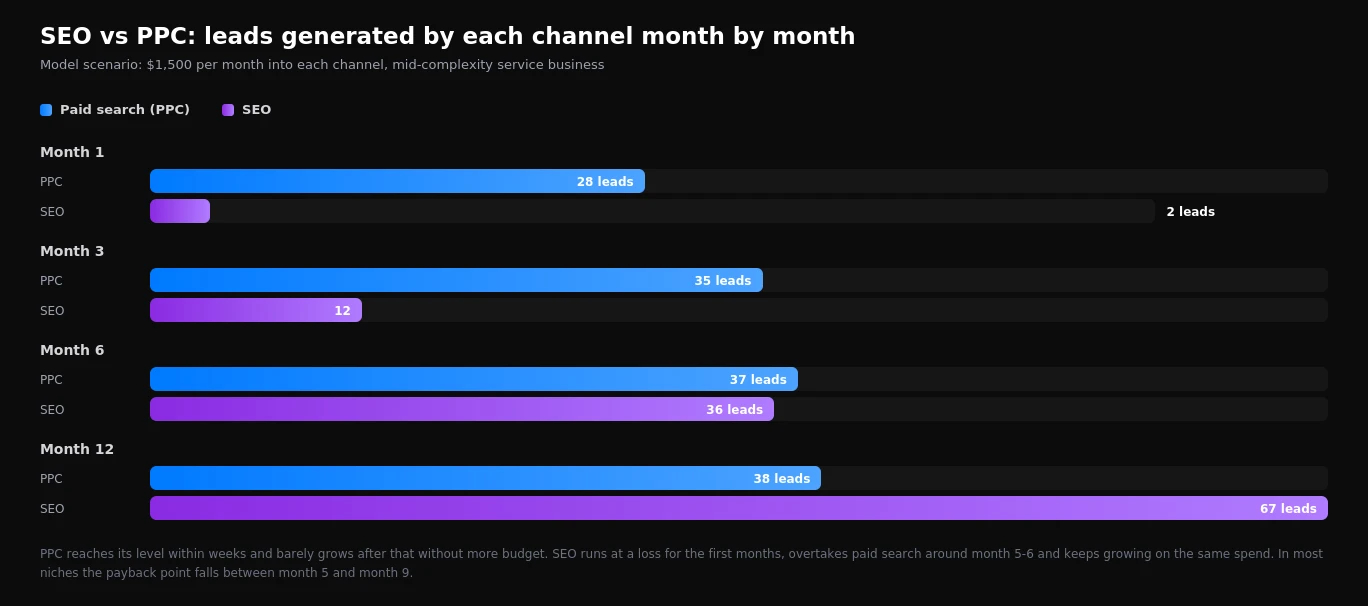
This is why comparing them over a single month is meaningless. In month one paid search wins by a landslide; in month twelve it loses. The right question is not which is better, but over what horizon you are counting money.
What each one actually costs
Here are realistic ranges for 2026, drawn from what it takes for each channel to genuinely work rather than from the lowest advertised entry prices.
Small business, narrow niche
$800-1,500
SEO: $700-1,200 of work. Paid: $600-900 of media plus management. One channel at a time.
Mid-size, competitive niche
$2,000-4,000
SEO: €1,500-2,500 in most European markets, content and links included. Paid: $1,500-3,000 of media plus management. Both channels become viable.
E-commerce or aggressive growth
$5,000+
SEO across technical work, content and links. Paid with category-level campaigns and a product feed.
The key structural difference is where the money goes. In paid search 60-75% of the budget goes straight to clicks, meaning you are paying Google. In SEO nearly all of it goes into work: content, technical fixes, links, analysis. You pay the search engine nothing.
Side by side on the specifics
| Dimension | Paid search | SEO |
|---|---|---|
| First results | 1-3 days | 4-6 months |
| Payback on spend | from month one | months 5-9 |
| What happens if you stop | traffic disappears within a day | traffic holds for months |
| Cost per lead over time | rises with competition | falls as rankings improve |
| Predictability | high, forecasts and calculators exist | moderate, depends on competitors and algorithms |
| Control over outcomes | full, you decide who sees you | partial, the search engine has the last word |
| User trust | lower, the ad label is visible | higher, organic results read as recommendations |
| Testing a hypothesis | 2-3 days | 2-3 months |
SEO is often sold as free traffic. It is not. The click is genuinely free, but before a page can produce those clicks you have already paid for research, content, technical work and links. The difference is not that SEO is free, but that you pay once for a result that keeps working, rather than paying again for every single visitor.
The same business, costed both ways
Take a cosmetic dentistry practice in a mid-size city and model both scenarios over a year. The budget is $1,800 monthly, or $21,600 for the year.
$21,600 into paid search
Of $1,800 monthly, about $1,350 goes to clicks and the rest to management. Dental clicks with tight local targeting run around $8, giving 168 clicks. A 4% site conversion produces 7 enquiries at $257 each. If a third book, that is roughly 2-3 patients monthly at about $770 acquisition cost.
Steady and predictable, but in December you have exactly what you had in January: switch the ads off and the flow stops the same day.
$21,600 into SEO
The first three months go on technical work, structure and the first service pages, producing almost nothing: 8-12 enquiries for the quarter. Growth starts in month four, reaches 25-35 monthly by month six and 60-80 by month twelve.
That is roughly 380 enquiries for the year, or about $57 each. Expensive early, very cheap late. And in December the site keeps working even if you pause the retainer.
$1,100 ads plus $700 SEO
Ads deliver a steady flow from day one, so the practice is never empty. SEO grows more slowly on the smaller budget but reaches 35-45 enquiries monthly by month twelve.
By the end of the year total volume exceeds either single-channel scenario, and blended cost per lead keeps falling as the organic share grows. This is why most businesses thinking beyond a twelve-month horizon choose the split.
When paid search is clearly the answer
- The business just launched and needs sales now. Waiting six months is not an option when rent is due this month.
- Seasonal products. Christmas trees in December, air conditioning in July. SEO will not arrive in time: by the time the page ranks, the season is over.
- A one-off promotion or product launch. You need traffic on specific dates, not gradual growth.
- You are still validating the idea. Not sure anyone will buy? Ads answer that in a week for modest money.
- A niche where SEO is barely viable. If the results page is wall-to-wall marketplaces and aggregators with budgets you cannot match, paid search is the more realistic route.
When SEO is clearly the answer
- An established business planning to continue. Any horizon beyond a year makes SEO mathematically better.
- Expensive clicks in your category. Legal, construction, medical equipment: when a click costs $20-50, organic becomes the only way to get traffic at scale.
- Heavy informational demand. People search "how to choose", "how much does it cost", "what is the difference" long before buying. Advertising against those queries is expensive; organic collects them for nothing.
- A large catalogue. A shop with a thousand products physically cannot advertise every item, while organic covers the entire long tail.
- Categories where trust decides. Health, finance, education. People in these categories deliberately scroll past the ads.
What actually determines the choice
Rather than general advice, here are four factors, weighted by how much they really move the decision.
It usually comes down to the horizon. If an owner does not know whether the business will exist in a year, investing in SEO is irrational: the effect simply will not arrive in time. If the business has run for five years and will run for five more, every month without SEO is free traffic that could already have been arriving.
Work out what a click costs in your category and multiply it by how many clicks you need for one enquiry. If that exceeds what your margin can absorb, paid search will only ever be a temporary solution for you. At that point SEO stops being a preference and becomes a necessity.
What SEO gives you that ads never will
- Traffic on informational queries. Someone searching "how much do veneers cost" is not ready to book, so bidding on that is expensive. But that is exactly the moment the choice of provider forms, and an organic article shapes it.
- The long tail. Thousands of rare queries each producing a handful of visits. Together they frequently exceed half of all traffic, and no campaign can capture them because the volumes are too small to bid on.
- Cheaper remarketing. Organic traffic fills your audience lists. People who arrived from search and left later see your remarketing, and those impressions cost very little.
- An asset with resale value. A site with traffic is something you can sell with the business. An ad account's history is worth nothing.
- Protection against bid inflation. When a well-funded competitor enters the market, your ad costs rise immediately. They cannot take your organic positions nearly as fast.
What ads give you that SEO never will
- Speed. Launch in the morning, first enquiry by lunch. Nothing else works that way.
- Precise control. You choose the city, the hours, the device, the audience. In organic you appear to whoever the search engine decides.
- Fast testing. Testing five offers in a week is only possible in ads. In SEO the same test takes a quarter.
- Guaranteed presence on your own brand. Competitors bid on your company name. Without a branded campaign they intercept your own customers.
- Seasonal scaling. Before the holidays you can triple the budget and get a matching lift. Organic does not scale on command.
The common mistake: choosing instead of combining
The most frequent scenario is a business that spends everything on ads for three years, then adds it up and realises it has handed over six figures and owns no traffic of its own. The money left, no asset arrived.
The reverse mistake also happens: a company puts everything into SEO, sits without leads for six months, loses patience and cancels the programme a month before results were due.
| Business stage | Ads | SEO | Reasoning |
|---|---|---|---|
| First 3 months | 80% | 20% | Sales and demand validation come first; SEO is groundwork only |
| Months 4-9 | 60% | 40% | Ads feed the business while SEO builds momentum on content |
| After a year | 40% | 60% | Organic already delivers; ads cover the highest-intent queries |
| Mature business | 30% | 70% | Organic is the base; ads handle seasons and new lines |
How to tell whether SEO will work in your niche at all
Before committing money, spend half an hour on a simple check. It does not replace an audit, but it will save you from obviously losing scenarios.
- Look at who ranks for your main terms. If all ten slots belong to Amazon, marketplaces and aggregators, your odds are poor. If ordinary company sites appear among them, there is room.
- Check whether anyone searches for your product. Google's Keyword Planner is free and shows monthly volume. A few dozen searches means organic will not sustain you.
- Note how old the competitors are. If every site in the top ten has existed for a decade, getting there takes longer. Not a reason to skip SEO, but a reason to plan a longer runway.
- Look at your own site the way a crawler does. If it loads in five seconds, has no mobile version and consists of two pages, the money belongs in the site first.
- Calculate what a customer costs you today. Without that number you cannot evaluate any channel honestly.
If an agency promises top positions within a month, either the term is entirely uncompetitive, such as your own company name, or you are being misled. Realistic timelines for commercial queries start at four months in simple niches and eight in competitive ones. Nobody who genuinely understands search offers ranking guarantees.
Three real-world scenarios
General rules are easier to grasp through specific businesses. Here are three situations that come up constantly, and the answer for each.
Appliance repair service
Demand is urgent and fully formed: the washing machine is broken, the customer is looking for a technician right now and will call whoever answers first. Ads produce results from day one here, and there is never a good reason to abandon them.
But SEO works beautifully in this niche too, because the queries are simple and local. The right sequence is to run ads for immediate flow while building pages for every appliance type and every neighbourhood. Within a year most calls come from organic, and ads stay on the most expensive terms and slow periods.
Custom furniture maker
The decision cycle is long: people browse for months, compare, collect ideas. Ads underperform expectations here because clicks are expensive and the person is nowhere near ordering.
What they do have is an enormous mass of informational queries: how to choose finishes, what a custom kitchen costs, which materials suit a bathroom. That is SEO territory. Ads stay on the narrow high-intent terms while organic collects everyone still deciding. A 30/70 split favouring SEO nearly always wins.
Online school running short courses
The hardest case, because the product lives on launches. A cohort starts on a fixed date, enrolment runs three weeks, then pauses. SEO cannot help any specific cohort at that rhythm.
The answer is to separate the jobs. Ads fill each cohort, while SEO works not on the course page but on the school's blog: articles on the topics prospective students search. Within a year that blog feeds a steady stream into the mailing list, and every subsequent launch costs less because part of the audience is already warm without ad spend.
How to measure which channel works better for you
Comparing the two honestly is harder than it looks, because they live in different coordinate systems. Here is how to do it properly.
- Measure cost per customer, not per lead. Organic often produces more enquiries, but more of them are readers rather than buyers. Ads produce fewer, warmer ones. Compare paid orders.
- Separate branded from non-branded queries. This is the most common distortion in SEO reporting: people searching your company name would have found you anyway. Judge growth in non-branded traffic.
- Account for the lag. Money spent on SEO in March produces enquiries in August. Dividing one month's spend by the same month's leads is meaningless; use six-month windows.
- Look at assisted conversions. Someone reads an article, returns a week later via an ad and buys. Formally the ad gets credit, though organic created the customer. GA4 path reports show these chains.
- Compare comparable periods. A first month of ads always underperforms the third while algorithms learn, and early SEO months cannot be measured against a mature ad account.
When SEO and ads run together, both providers show growth in their reports and both are telling the truth. The ad platform counts its conversions, the SEO report counts organic growth, and the sum exceeds your actual order count. The only number worth trusting is the one in your CRM or order system.
What changed in 2026
Both channels shifted noticeably over the past two years, and it affects the decision.
- Ads got more expensive. Bids rise every year while automated strategies leave less room to win through manual tuning. Categories where a click cost $4 now sit at $6-7.
- AI answers appeared in the results. Some informational queries now resolve inside search without a click. That hit purely informational sites hard and commercial pages barely at all.
- Source credibility matters more. Both search results and AI answers increasingly cite sites with real expertise, named authors and reputation. Thin content written for crawlers has stopped working entirely.
- Ads now consume your organic content. Automated formats pull assets and copy straight from the site, so strong pages improve campaign performance too.
The general conclusion is simple: both channels became more expensive and more demanding of site quality. The era of winning through cheap clicks or high volumes of weak content has ended on both sides.
Two mistakes that cost the most
Beyond the strategic choice itself, two specific errors waste more money than anything else in both channels.
Sending both channels to the same weak page. A business argues for months about whether to fund SEO or ads while the landing page converts at 1%. Doubling that to 2% halves the cost per lead in both channels at once, and usually costs less than a month of either. Whenever conversion is under 2%, fixing the page beats adding budget anywhere.
Judging a channel before it has finished learning. Ad platforms need roughly 30-50 conversions before automated bidding stabilises, and SEO needs a full crawl and indexing cycle before rankings settle. Verdicts delivered in week two are noise. Set the review date at launch - six weeks for ads, six months for SEO - and hold to it unless something is obviously broken.
How the two channels feed each other
Running both is not simply doing two things at once. Each one makes the other cheaper, in ways that rarely appear in reporting.
- Search terms become content briefs. The ad account's search terms report shows the exact wording that produces enquiries, including phrasings no keyword tool suggests. Those become the pages SEO builds next, with proof of commercial value attached.
- Ads test titles before you commit. Two headlines can be tested in a week for the price of a few clicks. The winner becomes the page title, instead of guessing and waiting three months to find out.
- Organic pages lower ad costs. Better landing pages raise quality scores, which lowers cost per click for the same position. Content produced for SEO frequently improves paid performance without a single campaign change.
- Together they take more of the page. Occupying both an ad slot and an organic result for the same query measurably increases total clicks, more than either would produce alone.
- Ads cover SEO's gaps instantly. A page that dropped in rankings, a new service with no content yet, a seasonal peak: ads fill each gap the same day while organic catches up.
How much time each channel takes
This rarely comes up while choosing, and then it turns out the business was not ready for the workload.
| What it needs from you | Ads | SEO |
|---|---|---|
| Involvement at launch | a few hours for briefing and landing pages | a few days for access, structure and sign-off |
| Monthly involvement | 1-2 hours on reports and decisions | 3-6 hours reviewing content and changes |
| Resources required | media budget, landing pages | site access, a developer, subject expertise for content |
| What slows it down | long approval cycles on ad copy | no developer available for technical fixes |
The most common reason SEO fails to deliver is not the agency but recommendations sitting unimplemented for months. If you have no developer and nobody to review content, solve that before starting rather than after.
Frequently asked questions
Which is cheaper, SEO or paid search?
Over six months, ads, because SEO has not yet paid back. Beyond a year SEO becomes cheaper and the gap keeps widening. In most niches the second-year cost per organic lead is two to three times lower than the paid equivalent.
Can I do SEO only, without ads?
Yes, if the business already has customers from other sources and can survive six months without results from the new channel. For a startup it is risky: the money runs out before the rankings arrive.
Can I run ads only, without SEO?
Yes, and plenty of businesses do so for years. The downside is permanent dependence on the budget: every new customer costs money, and that amount only grows as competition intensifies.
What if the budget is very small?
Start with ads on the highest-intent queries with tight geographic targeting. That produces leads and shows you which terms convert. In parallel, do the minimum SEO yourself: basic page optimisation and a Google Business Profile cost nothing and often move the needle.
How long until SEO pays back?
In simple, low-competition niches, from month five or six. In competitive ones, from month eight to twelve. If a year of work has produced nothing at all, the problem is the approach rather than the timeline.
Will AI in search damage SEO?
It already affects it. Generated answers at the top of the page absorb some clicks on informational queries. But commercial queries such as "buy" or "pricing" are barely touched, and the pages AI cites are drawn from the organic results themselves. Quality SEO matters more than before; part of its value has simply moved from clicks to citations.
Do ads help organic rankings?
Not directly - ad spend does not improve organic positions. Indirectly, yes: ads bring people to the site, they remember the brand and later search for it by name, and branded search is a signal the engine notices.
What if rankings improved but leads did not?
That means traffic is arriving on the wrong queries or the page is not persuading. The usual causes: informational articles ranking instead of commercial pages, no visible pricing, no easy way to enquire. Audit the path from query to action rather than the rankings.
Can I shift budget from ads to SEO without a dip?
Not abruptly. Ads stop instantly, organic does not appear the next day. The sensible approach is to reduce ad spend gradually as specific queries reach the top, so you can see which campaigns are safe to retire without losing leads.
Where should I start if I have no website yet?
With the website. Both channels send traffic somewhere, and if that page is poor the money burns either way. Get the structure, speed and offer right first, then promote it.
Choosing between SEO and ads is really a choice between fast money now and cheaper customers later. The right answer almost always depends on how many months your business can wait. If you want to see the numbers for your own niche and understand which channel pays back sooner in your case, talk to our team. If you would rather work through the figures yourself first, start with the cost breakdowns: what SEO costs and what Google Ads costs.
Want results like this for your brand?
Get a free strategy call and a tailored proposal within one business day.
Get a Free Proposal