Sep 17, 2026
Google Ads Specialist, Consultant or Agency: Who to Hire and What It Costs

Sooner or later, every business advertising on Google faces the same question: who should run the ads. A freelancer, an agency, an in-house specialist, or a consultant who supports the team. Each option has its own price, strengths and typical problems, and the wrong choice costs more than the contractor's fee: it costs ad budget spent without results.
Below is an honest comparison of the four formats with typical prices in the US and Europe, the questions worth asking before signing, and the red flags that should send you looking elsewhere.
0
ways to run Google Ads
$0+
a month for campaign management
$0K
average US PPC specialist salary, per Glassdoor
0%
of primary conversions in audited accounts with no events in a year
A freelancer is the cheapest way in, with direct communication, but you depend on one person. An agency costs about the same or a little more and brings a team, continuity and processes, though your account may get less attention than promised. An in-house specialist makes sense when advertising is a large, permanent channel, but salary alone runs to an average of around $71,000 a year in the US, and there is no second opinion. A consultant does not run the ads but supports the team: audits, strategy, training. Whatever the format, the ad account must belong to you, and reporting must be built on leads and sales, not clicks.
The four formats compared
| Format | Typical cost | Strengths | Weaknesses |
|---|---|---|---|
| Freelancer | $500-$5,000 a month, or 10-15% of spend | Price, direct communication, flexibility | One person: holidays, illness, overload |
| Agency | $500-$5,000 a month, or 12-20% of spend; often €1,000-€4,000 in Europe | A team, processes, cover without downtime | Account manager turnover, standardised approaches |
| In-house specialist | US $55,600-$91,300 a year; UK around £36,000, plus taxes and tools | Deep knowledge of the business, fast decisions | No second opinion, hard to judge the quality of the work |
| Consultant | A one-off project or a few hours a month | Independent view, experience across many accounts | No day-to-day management; needs a team to implement |
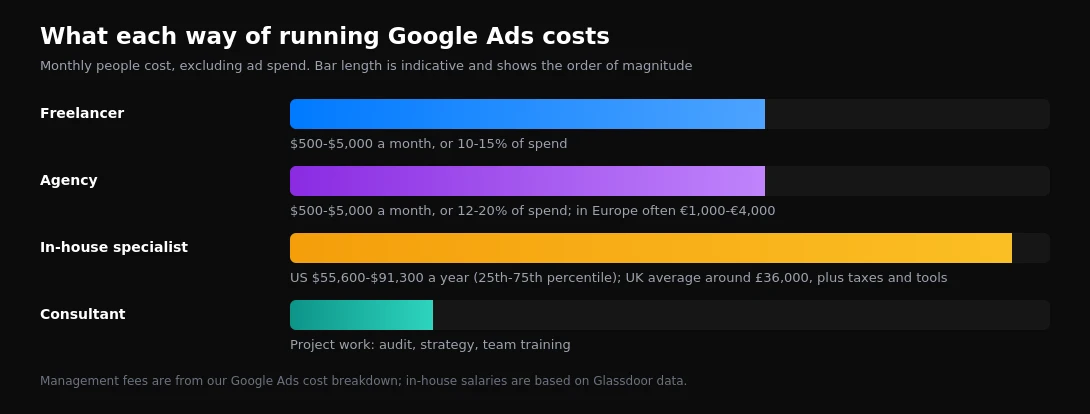
Management fees come from our Google Ads cost breakdown; in-house salaries are based on Glassdoor data for the US and UK. The ad budget paid directly to Google is separate in every option.
Freelancer
The most common choice for a small business. A freelancer usually charges a fixed fee or a percentage of spend, works directly with the owner and reacts quickly to changes.
The main risk is depending on one person. When a freelancer goes on holiday, falls ill or takes on too many clients, the account runs unsupervised. The second risk is less obvious: one person is rarely equally strong in advertising, analytics and tracking, so conversion tracking often ends up as the weak spot.
Best for: one or two campaigns in a single niche, a moderate budget, and an owner willing to keep an eye on results.
Agency
An agency provides a team: an ads specialist, an analyst, sometimes a designer and copywriter. If an account manager leaves, the work does not stop. There are processes, report templates and experience across many industries.
The flip side is the risk that your account gets fewer hours than intended, especially on a small budget. Large agencies lean towards standard solutions, and a change of account manager means each new specialist has to learn your business again.
Best for: several channels or campaigns, a need for analytics and tracking, and an owner who does not want to depend on one person.
In-house specialist
An in-house PPC specialist makes sense when advertising is a large, permanent channel and the business is complex enough that deep immersion pays off. According to Glassdoor, the average US PPC specialist salary is around $71,000 a year, with the 25th to 75th percentile running from $55,600 to $91,300; in the UK the average is around £36,000. On top of that come taxes, tools, training and management time.
The biggest problem with the in-house model is the lack of a second opinion. If the specialist sets up tracking incorrectly or sticks to outdated approaches, there is often nobody in the company able to notice. That is why in-house specialists benefit from a periodic external audit.
Best for: a large, stable budget, several advertising streams, and a manager who understands marketing.
Consultant
A consultant does not manage campaigns day to day. Their job is to look at the account independently, find where money leaks, build a strategy, train the team or help choose a contractor. The format is a one-off project or a few hours a month.
Best for: companies with an in-house specialist or agency that want an independent check, and anyone still deciding who to trust with their advertising.
Hybrid models that often work better
The choice does not have to be either-or. In practice, the most resilient setups combine formats:
- In-house specialist plus an external audit every six months. You keep deep business knowledge, and the outside view catches what cannot be seen from within.
- Agency plus an in-house marketer. The agency runs the campaigns; the marketer owns lead quality, the CRM and feedback from sales.
- Freelancer plus a dedicated tracking setup. One person runs the campaigns, while conversion tracking is set up once by people who specialise in exactly that.
How to assess a contractor after three months
Three months is a reasonable period to see which way an account is heading. Look past the clicks at five things:
- Cost per lead or customer and its trend, reconciled with the CRM rather than just the dashboard report.
- The state of conversion tracking. Whether redundant primary actions were removed and whether the numbers match real leads.
- Search term management. Whether the share of spend on irrelevant queries has fallen.
- Initiative. Whether the contractor proposes tests and changes, or only reports on what happened.
- Transparency. Whether you can log into the account yourself and understand what is going on.
What is left behind after contractors change
When auditing ad accounts, we see the same thing again and again: each new contractor starts with the campaigns, not with what accumulated in the account before them.
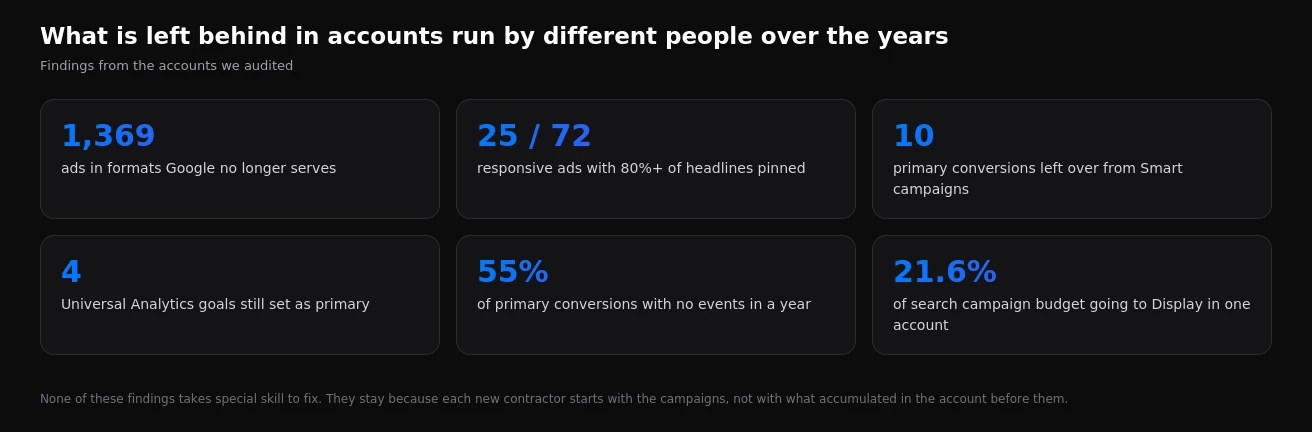
1,369 ads in formats Google stopped serving long ago. Universal Analytics goals still marked primary. Smart campaign leftovers among primary conversions. Pinned headlines carried over from old text ads. We covered these findings in detail in our pieces on the structure of audited accounts and conversion tracking failures. None of them proves poor work by any particular person, but each shows that nobody reviewed the whole account when the contractor changed.
Questions to ask before signing
- Who will own the ad account? The right answer: you. The contractor gets access through their manager account rather than creating an account in their own name.
- How will you check that conversions are counted correctly? If the answer is "we'll look in the dashboard", that is a warning sign.
- What will the report show? Leads, sales, cost per customer. Not just clicks, impressions and CTR.
- How do you handle search terms and negative keywords? A good answer includes a routine and examples.
- How are you paid, and is there a conflict of interest? With a percentage of spend, the contractor benefits when the budget grows. That is not wrong, but cost per lead needs watching.
- What happens if we stop working together? Access stays with you, and the setup is documented.
- Can you show results in numbers? Case studies with leads, sales or return, not just reach screenshots.
Red flags
| What you hear or see | Why it is a problem |
|---|---|
| A guaranteed top position or a set number of leads | Results depend on the auction, the market and the site; no one can honestly guarantee them |
| The account is created under the contractor's name | You lose the history and data when you part ways |
| Reports on clicks and impressions only | You cannot see whether ads make money |
| Refusal to give you access to the account | You cannot verify what is happening |
| "We'll set it up in a day and you can forget about it" | Ads without daily oversight slowly eat the budget |
Frequently asked questions
Can I run Google Ads myself?
Technically, yes. But the first months of self-management usually cost more than a specialist would, because budget leaks into irrelevant queries while you learn the interface. Running ads yourself makes sense when the niche is narrow, the geography small and the budget modest.
Is paying a percentage of ad spend a bad model?
No; for larger budgets it is common and convenient. But it makes more money for the contractor when you spend more, so track cost per lead and per customer yourself rather than relying on the contractor's report.
How often should we commission an independent audit?
Every six months for active accounts, plus whenever the contractor changes, after a website update, and whenever cost per lead rises noticeably for no obvious reason.
Where to start
Before choosing a format, it helps to understand the state your account is in right now. An independent audit shows what works, what is broken and how much work is needed, and gives a new contractor or in-house hire a clear plan instead of guesswork. That way you compare candidates not on promises but on how they propose to fix specific problems.
We run exactly that kind of one-day Google Ads, GA4 and GTM audit, and if you are looking for a team to manage your ads on an ongoing basis, see how we work with Google Ads.
Want results like this for your brand?
Get a free strategy call and a tailored proposal within one business day.
Get a Free Proposal