Nov 6, 2026
Google Ads for Pest Control 2026: Exterminator Clicks Cost $31-35. What to Bid On and What to Block
$35.00. That is what one click on "exterminator near me" costs on average in the United States. One click, not one customer.
This guide shows what pest control keywords cost in the US and the UK, which searches bring paying customers and which bring people looking for a spray can, how to work out a budget and how to structure campaigns. All prices come from our own Keyword Planner pull from November 2026.
$0.00
"exterminator near me", US average CPC
$0.72
"pest control", US average CPC
$0.45
"bed bug treatment", US - many DIY searchers
$0.41
"pest control", UK average CPC
In the US, almost every search that signals "I want to hire someone" costs $23-35 per click: "pest control" is $30.72, "exterminator near me" is $35.00, "termite treatment" is $23.26. Searches where many people want a product and not a technician are far cheaper: "bed bug treatment" is $9.45 and "mosquito control" is $8.41. In the UK the core term "pest control" costs $5.41, about 5.7 times less than in the US. To make the numbers work, split campaigns by pest and urgency, block DIY and job-seeker searches with negative keywords, track calls, and judge the cost of a lead against what a recurring customer is worth to you over time, not against the first visit.
What pest control clicks cost in the US, by service
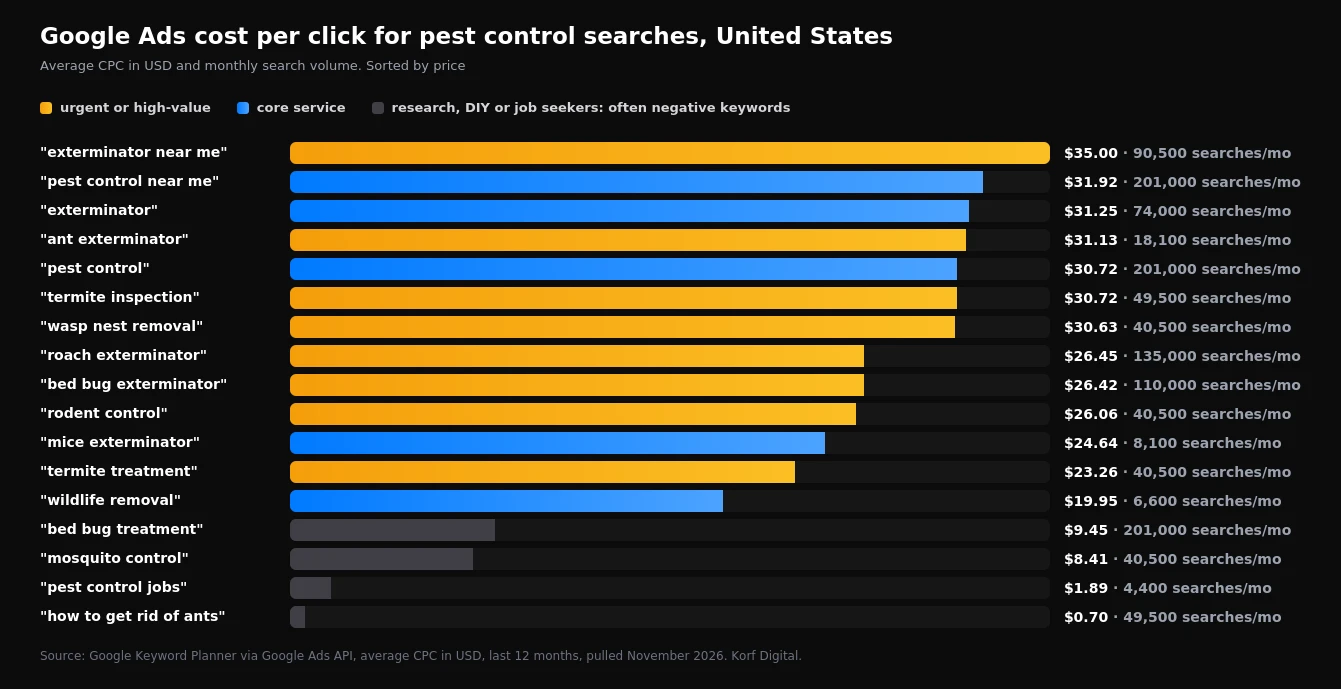
Urgent and high-value searches. "Exterminator near me" ($35.00), "ant exterminator" ($31.13), "termite inspection" ($30.72), "wasp nest removal" ($30.63), "roach exterminator" ($26.45), "bed bug exterminator" ($26.42), "rodent control" ($26.06) and "termite treatment" ($23.26). The person names the pest and wants a professional.
Core searches. "Pest control near me" ($31.92), "exterminator" ($31.25), "pest control" ($30.72), "mice exterminator" ($24.64) and "wildlife removal" ($19.95). They cost about the same as the urgent group. There is no discount for a general term: of the 17 US keywords we checked, 12 sit in the $23-35 band, and "wildlife removal" is just below it.
Research, DIY and job searches. Here the price falls sharply. "Bed bug treatment" costs $9.45 while "bed bug exterminator" costs $26.42, which is 2.8 times more for the same pest. "Exterminator" means a hire; "treatment" also covers sprays and powders. "Mosquito control" at $8.41 has the same mixed intent. Neither is truly cheap, though: $8-9 a click is real money if many visitors wanted a product. At the bottom, "pest control jobs" costs $1.89 and "how to get rid of ants" costs $0.70. The last one is pure DIY and 50 times cheaper than "exterminator near me".
| Keyword (US) | Searches per month | Average CPC | Group |
|---|---|---|---|
| exterminator near me | 90,500 | $35.00 | Urgent / high-value |
| pest control near me | 201,000 | $31.92 | Core |
| exterminator | 74,000 | $31.25 | Core |
| ant exterminator | 18,100 | $31.13 | Urgent / high-value |
| pest control | 201,000 | $30.72 | Core |
| termite inspection | 49,500 | $30.72 | Urgent / high-value |
| wasp nest removal | 40,500 | $30.63 | Urgent / high-value |
| roach exterminator | 135,000 | $26.45 | Urgent / high-value |
| bed bug exterminator | 110,000 | $26.42 | Urgent / high-value |
| rodent control | 40,500 | $26.06 | Urgent / high-value |
| mice exterminator | 8,100 | $24.64 | Core |
| termite treatment | 40,500 | $23.26 | Urgent / high-value |
| wildlife removal | 6,600 | $19.95 | Core |
| bed bug treatment | 201,000 | $9.45 | Research / DIY / jobs |
| mosquito control | 40,500 | $8.41 | Research / DIY / jobs |
| pest control jobs | 4,400 | $1.89 | Research / DIY / jobs |
| how to get rid of ants | 49,500 | $0.70 | Research / DIY / jobs |
These are national averages over 12 months. Demand in pest control moves with the season and the pest: stinging insects and mosquitoes are a warm-weather problem, rodents move indoors when it gets cold, and bed bugs and roaches bring calls all year. Plan budgets by pest, not as one flat monthly number.
The UK market: the same searches for a fraction of the price
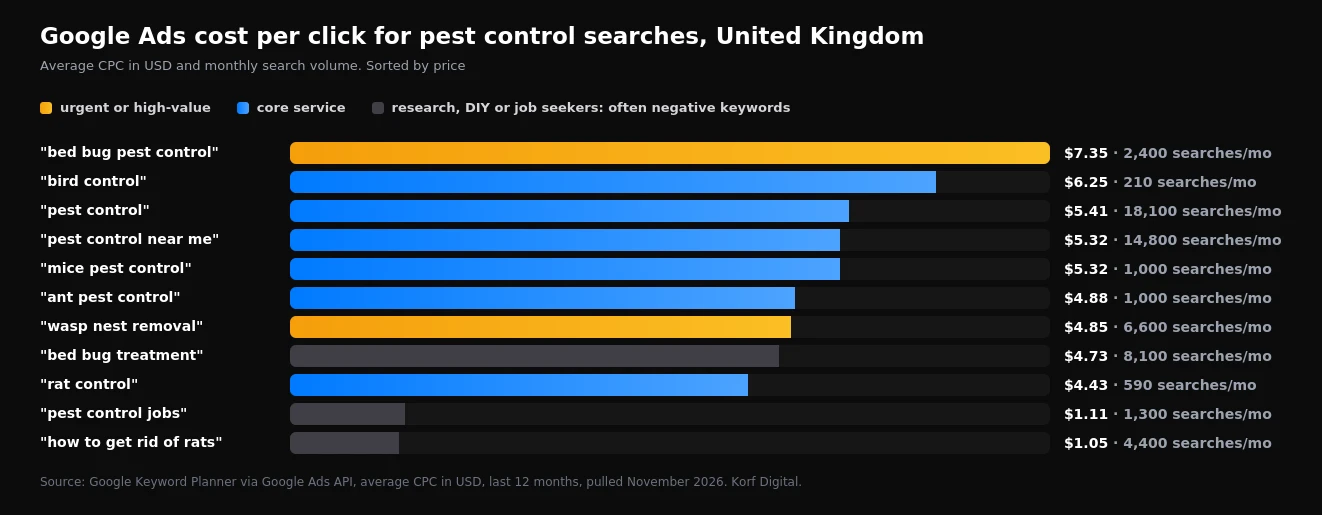
In the UK, "pest control" costs $5.41 and "pest control near me" costs $5.32. That is 5.7 and 6 times less than the same terms in the US. Service keywords sit in a narrow band: "bed bug pest control" is the most expensive at $7.35, then "bird control" ($6.25), "mice pest control" ($5.32), "ant pest control" ($4.88), "wasp nest removal" ($4.85) and "rat control" ($4.43).
One thing differs from the US. "Bed bug treatment" in the UK costs $4.73, almost the same as the core terms, so the DIY discount you see in America is nearly absent. Only the clear non-buyers are cheap: "pest control jobs" at $1.11 and "how to get rid of rats" at $1.05.
| Country | Keyword | Average CPC |
|---|---|---|
| United States | pest control | $30.72 |
| Germany | schädlingsbekämpfung | $7.24 |
| United Kingdom | pest control | $5.41 |
| Poland | dezynsekcja | $3.22 |
| Ukraine | дезінсекція | $1.72 |
The US click costs more than four times the German one and almost 18 times the Ukrainian one. For the wider picture across industries, see our Google Ads CPC by country comparison.
Budget math: what a lead really costs
Take a US company with $3,000 a month, bidding on terms that average around the "pest control" price of $30.72.
- $3,000 ÷ $30.72 = about 97 clicks.
- How many clicks become a call or a form is not in our data, so this part is an illustrative assumption. Assume 1 in 10 clicks (10%): about 10 leads, or $307 per lead ($30.72 ÷ 0.10).
- At a weaker 5%: about 5 leads, $614 per lead.
- At a stronger 15%: about 15 leads, $205 per lead.
Not every lead becomes a customer, so divide again by your own close rate. Then compare the result with what a customer is worth. If your average one-off job is worth $X, a $307 lead may look too expensive. But pest control rarely sells one visit. Much of the revenue comes from recurring plans, termite contracts with renewals, and referrals. A customer who stays on a plan for years is worth many times the first invoice, and that lifetime value is the number to set against the cost of a lead. Use your own retention figures, not a guess. Our ROI, ROMI and ROAS calculator helps with the arithmetic.
Campaign structure that works for pest control
- Split by pest and urgency. Termites, bed bugs, rodents, roaches and ants, stinging insects, wildlife, and general pest control each get their own campaign or ad group. A termite inspection and a wasp nest are different customers, so they need separate budgets, ads and bids.
- Run seasonal campaigns on purpose. Mosquito and wasp campaigns can be paused or cut back out of season, and rodent budgets raised when the weather turns.
- Keep "treatment" and "exterminator" apart. The $9.45 and $26.42 bed bug terms carry different intent. Use separate ad groups and bid lower on the mixed-intent one.
- Set the location to your real service area. Use "presence" targeting, so you pay for people who are in the area, not people interested in it.
- Match the schedule to who answers the phone. Run around the clock only for services you really dispatch at any hour. Otherwise show ads when a person can pick up, and check results by day and hour with an ad schedule analysis.
- Make calling easy. Add call assets to every campaign. Someone who has just found a wasp nest wants to talk, not fill in a form.
- One landing page per pest. A bed bug ad should lead to a bed bug page with a phone number, not to the homepage.
- Add Local Services Ads. LSA charge per lead, not per click, and show a "Google Verified" badge; the old Google Guaranteed money-back guarantee was discontinued. Since 1 October 2026 a missed call over 20 seconds during business hours is a billable lead, so answer the phone. In the UK, LSA covers around 30 home service categories. See Local Services Ads vs Google Ads for how the two work together.
- Smart bidding only after tracking. Turn it on once calls and forms are counted correctly, not before.
Negative keywords starter list for pest control
The job-seeker and how-to keywords in our data are cheap, but a click from someone who will never hire you is still wasted, and broad match will pull these searches into a $30 campaign. Add this list before launch:
jobs
job
hiring
salary
career
technician training
license
certification
course
how to
diy
homemade
home remedy
natural
spray
trap
bait
poison
killer
repellent
home depot
walmart
amazon
free
pictures
Then review the search terms report weekly and keep adding. Be careful: do not block "trap" if rodent trapping is a service you advertise. The full method is in our negative keywords guide.
Tracking: calls first
Most pest control leads arrive by phone, so an account that only counts forms sees a small part of its results. You need:
- Call tracking - calls from ads and from the website, counted only above a minimum length. See the call tracking guide.
- Form tracking - every quote and inspection form, counted once.
- Importing real outcomes - sending back to Google Ads which leads became booked jobs and which signed a recurring plan. A plan customer and a one-off wasp job look identical as "a call". The setup is described in enhanced conversions for leads.
Common mistakes we see in audits
- One campaign for every pest, so the budget goes wherever Google finds the most searches.
- No negative keywords, with DIY and product searches eating the budget.
- Job seekers clicking the ads because "jobs" and "hiring" were never excluded.
- Broken or missing conversion tracking, often with page views counted as leads.
- No call tracking, although most leads come by phone.
- All traffic sent to the homepage instead of a page about the pest searched for.
- Ads running at hours when nobody answers the phone.
Do not switch to automated bidding while the account counts the wrong things as conversions. If a page view or a five-second call is a "conversion", the system will find more of exactly those, at $30 a click.
Mark recurring-plan sign-ups as a separate, more valuable conversion than one-off jobs. Then you can see which pests and keywords bring long-term customers and move budget toward them.
FAQ
How much does Google Ads cost for pest control companies?
In the US, hiring-intent keywords cost $23-35 per click on average: "pest control" is $30.72 and "exterminator near me" is $35.00. In the UK the same core term costs $5.41.
Is Google Ads worth it for exterminators?
It can be, if you measure against the value of a customer and not a single visit. At $30 a click a lead is expensive, so the account pays off when leads turn into recurring plans or high-value work such as termite jobs.
Why is "bed bug treatment" so much cheaper than "bed bug exterminator"?
Because the intent is mixed. "Bed bug exterminator" ($26.42) is a search for a company. "Bed bug treatment" ($9.45) also attracts people looking for sprays and do-it-yourself methods, so advertisers bid less.
Should I bid on "pest control jobs" or "how to get rid of ants" because they are cheap?
No. At $1.89 and $0.70 they look like a bargain, but the people searching want a job or a home remedy. Add them as negatives.
What budget do I need to start?
At $30.72 a click, $3,000 buys about 97 clicks a month in the US; at $5.41, $1,000 buys about 185 in the UK ($1,000 ÷ $5.41). If the budget is small, start with one or two pests where a customer is worth the most to you instead of covering everything thinly.
Methodology and sources
Google Keyword Planner via the Google Ads API, average CPC in USD over the last 12 months, pulled in November 2026. Figures are national averages; costs in your city and season will differ. The conversion rates in the budget section are illustrative assumptions, not measured data.
Want to know where your pest control budget is going right now? Order a Google Ads audit: we show which spend brings calls and which does not.
Want results like this for your brand?
Get a free strategy call and a tailored proposal within one business day.
Get a Free Proposal