Nov 3, 2026
Local Services Ads vs Google Ads in 2026: Pay per Lead or per Click? Costs, Changes and When to Use Both

$76.38. That is what one click on "emergency plumber" costs in Google Search ads in the US, according to our Keyword Planner data. One click, not one customer. On Local Services Ads you pay nothing for clicks at all: you pay only when someone calls, messages or books. Third-party benchmarks put a plumbing lead there at roughly $57-69.
So should every local business switch? Not quite. In 2026 Local Services Ads are also changing more than at any point since launch: they are moving into Google Ads as a Performance Max campaign type, the money-back guarantee is gone, and missed calls are now billable. Below: how both formats work today, what each really costs, and when to use one, the other or both.
0
monthly US searches for "local service ads"
0 sec
a missed call this long is now a billable lead
0
countries where Local Services Ads run
0
when non-US accounts move into Google Ads
Local Services Ads charge per lead (a call, message or booking) and show at the very top of Search and Maps, but give you no keywords, no ad text and no landing page. Search ads charge per click and give you full control over keywords, ads, landing pages and tracking. LSA usually wins for core, everyday jobs in trades like plumbing, HVAC, roofing and electrical, if you have reviews and answer the phone fast. Search wins for specific high-value services, emergencies you want to own, areas or job types LSA does not cover, and businesses that need a website to sell. Most local service businesses with a decent budget do best running both and comparing cost per booked job, not cost per lead. In 2026 Google is migrating LSA into Google Ads as Performance Max with pay-per-lead goals: US first, other countries in 2027.
How Local Services Ads work in 2026
Local Services Ads (LSA) are the ads with a business name, rating and verification badge that appear above regular search ads for searches like "plumber near me". People can call, message or, in the US and Canada, book directly from the ad.
- You pay per lead, not per click. A lead is a call, message or booking that relates to your business. Repeat contacts from the same number or email within 15 days are not charged again.
- Missed calls now count. From 1 October 2026, a missed call during business hours is a billable lead if the caller stays on the line for more than 20 seconds. If your phone system asks callers to press a key, the 20 seconds start after the key press.
- Bad leads are credited automatically. Google reviews lead quality over a 30-day period and credits invalid leads on its own. The old manual dispute button is gone; you can still give feedback, but credits from feedback are occasional. Auto credits are not available for health care, tax specialists or advertisers in the EEA.
- Budget. In the standalone LSA dashboard you set an average weekly budget. After migration to Google Ads it becomes an average daily budget (weekly ÷ 7), and monthly spend is capped at the daily budget × 30.4.
The big 2026 change: LSA is moving into Google Ads
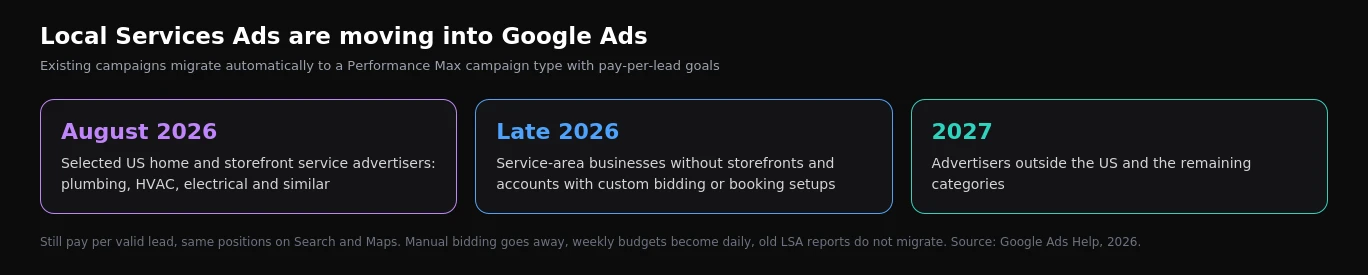
Google is moving existing LSA campaigns into Google Ads as a Performance Max campaign type with pay-per-lead goals. The migration is automatic and happens in waves: selected US home and storefront service businesses from August 2026, service-area businesses and accounts with custom bidding or booking setups in late 2026, and accounts outside the US and remaining categories in 2027.
What stays the same: you still pay only for valid leads, and ads still show only on Google Search and Maps in the same positions. Your Google Verified badge transfers automatically.
What changes:
- You manage budgets, targeting and replies in Google Ads, and the old dashboard redirects there.
- Manual bidding (a maximum price per lead) is removed. Vertical-level target cost per lead becomes a single campaign-level target, so businesses with several trades need separate campaigns.
- LSA performance reports do not migrate. Lead history does. Export or screenshot the reports you need before your account moves.
- BBB callouts are no longer supported.
If you relied on a manual "max per lead" bid to control costs, that lever disappears after migration. Set a realistic campaign-level target cost per lead and watch the first weeks closely: let the algorithm learn, but do not let it run unchecked.
Badges and verification: Google Guaranteed is gone
Since late 2025 Google has replaced Google Guaranteed, Google Screened and License Verified with a single Google Verified badge. The money-back guarantee that came with Google Guaranteed has been discontinued: customers could claim reimbursement only for services booked before 7 December 2025. Google says LSA ranking is not affected by the change.
Verification still depends on the category:
- Home services: background checks on the owner and business, general liability insurance and state licences, with extra screening for electricians, HVAC, plumbers, garage door companies and locksmiths.
- Lawyers: a bar check for each attorney.
- Legal, financial, real estate and tax: an identity check on the business owner.
- Health care: licence (NPI) verification and malpractice insurance.
- Everyone: a public, verified Google Business Profile. Google recommends at least 5 reviews and notes that some businesses may need 5 reviews to show at all.
Since August 2026 some new advertisers in the US can start getting leads after preliminary checks, before full verification is complete.
What decides who shows up first
Google lists three groups of ranking signals for Local Services Ads:
- Your bid.
- How likely you are to get the lead: how quickly you respond, how well your services and business description match the search (service, timing and location), and whether messages or bookings are switched on.
- Profile quality: review rating and count, average response time, photo quality and completed verification.
In practice this means a business with 120 good reviews that answers in minutes can beat a bigger competitor that bids more. On Search ads, reviews barely matter for position, while bid, ad relevance and landing page quality do.
Local Services Ads vs Search ads, side by side
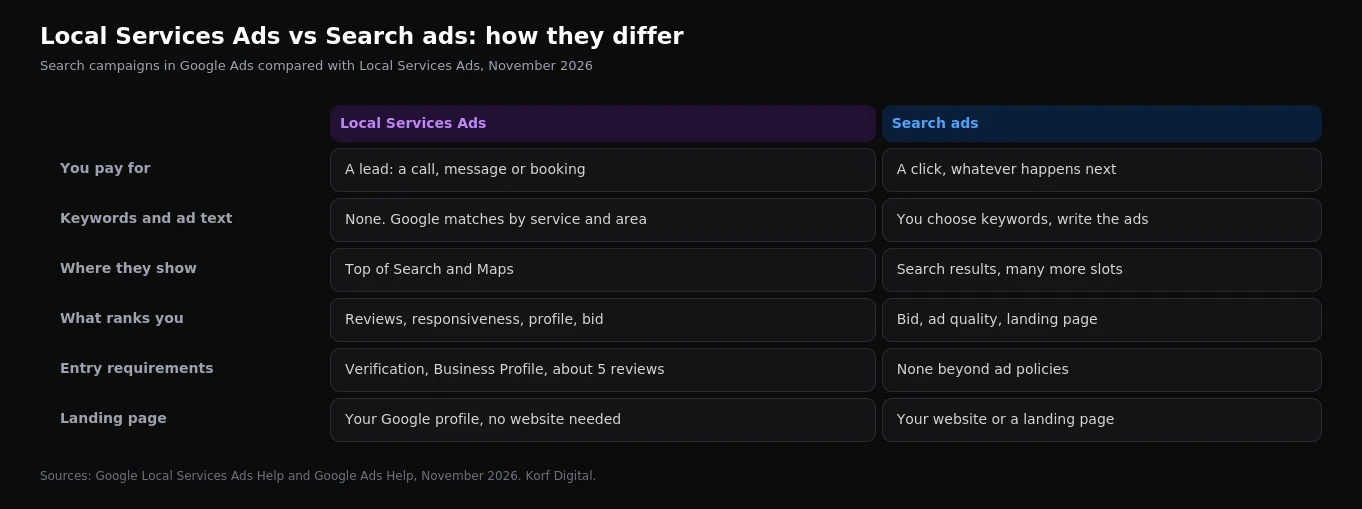
The core trade-off is simple: LSA gives you leads with less control, Search gives you control and charges for every click.
What each one really costs
Google does not publish average cost per lead for LSA. It only says that competing bids set the price. So any LSA numbers come from third parties, and Search click prices come from our own Keyword Planner pull. Treat the table below as a rough orientation, not a like-for-like comparison: one column is per click, the other per lead.
| Trade (US) | Search: average cost per click | LSA: cost per lead, third-party estimates |
|---|---|---|
| Plumbing | "plumber" $34.32, "emergency plumber" $76.38 | about $57-69 |
| HVAC | "hvac repair" $34.77, "ac repair" $46.46 | about $39-100 |
| Roofing | "roof repair" $40.95, "roofer" $22.79 | no reliable estimate found |
| Personal injury law | "personal injury lawyer" $170.62 | about $249 |
To compare fairly, turn Search clicks into leads. If 1 in 10 clicks on "plumber" becomes a call or form (an assumption, plug in your own rate), a Search lead costs $34.32 ÷ 0.10 = about $343. At 1 in 5 it is about $172. Even then, a Search lead for a specific job can be worth more than a generic LSA call, so the number that settles it is cost per booked job. Our ROI, ROMI and ROAS calculator includes a lead generation version for exactly this math.
When Local Services Ads are the better choice
- You offer core, everyday jobs in an LSA category: plumbing, HVAC, electrical, roofing, pest control, cleaning, locksmith, moving.
- You have solid reviews (dozens, not a handful) and someone who answers the phone within minutes, every working hour.
- You have no strong website or landing pages, and no time to manage keywords and ads.
- Your budget is modest and you would rather pay for conversations than for clicks.
When Search ads are the better choice
- High-value specific services. Water heater replacement, repiping, roof replacement, bathroom remodels: Search lets you target exactly those searches and send them to a page that sells that job.
- Emergencies you want to own. With Search you can run a separate 24/7 emergency campaign with its own bids, schedule and call ads. See how this works in our Google Ads guide for plumbers.
- Services or areas LSA does not cover. LSA targets by category and service area, so niche job types and specific towns are often better on Search.
- You need control. Negative keywords, ad text, landing pages, offers, schedule, device bids and proper conversion tracking are all yours in Search.
- Few reviews yet. A new business with 3 reviews will struggle on LSA. Search does not care about review count.
Running both: how to make them work together
Running LSA and Search at the same time is allowed, and for most local service businesses with a budget above a few thousand dollars a month it is the strongest setup. Google publishes no official guidance on combining them, so these rules come from practice:
- Split by job type. Let LSA catch generic "plumber near me" demand. Use Search for high-ticket services, emergencies and areas LSA misses.
- Track every lead in one place. Use call tracking on Search, record LSA leads, and put both into one CRM or spreadsheet with the outcome: booked, quoted, lost. Our call tracking guide covers the setup.
- Compare cost per booked job, monthly. Move budget to whichever channel books more profitable jobs, not whichever has cheaper leads.
- Feed results back. Import booked jobs into Google Ads so Search bidding learns which leads matter. See enhanced conversions for leads.
- Keep Search negatives tight. Job seekers, DIY searches and suppliers burn Search budget, not LSA budget. Start with our negative keywords guide.
The downsides of Local Services Ads nobody puts in the brochure
- Lead quality varies. Agencies have reported out-of-area and off-topic leads. Auto crediting helps, but you cannot dispute every lead yourself anymore.
- Missed calls cost money. Since October 2026 a missed call over 20 seconds is billable. If nobody answers, you pay for leads you never spoke to.
- No keywords, no copy, no landing page. You cannot exclude searches you do not want, test messages or send people to an offer page.
- Reviews decide a lot. Your position depends heavily on rating, review count and response time, which take months to build.
- Fewer slots. LSA shows only a handful of businesses per search, so in busy cities getting in is competitive.
- Less control after migration. Manual per-lead bids disappear when your account moves into Google Ads.
Where Local Services Ads are available
LSA runs in 11 countries: the US, Canada, the UK, Ireland, Germany, Austria, Switzerland, France, Belgium, Italy and Spain. The US has the widest set of categories, from home services and legal to health care, real estate, financial planning and tax, with some limits by state. In the UK the program covers around 30 home service categories, while lawyers and estate agents are available only in Greater London.
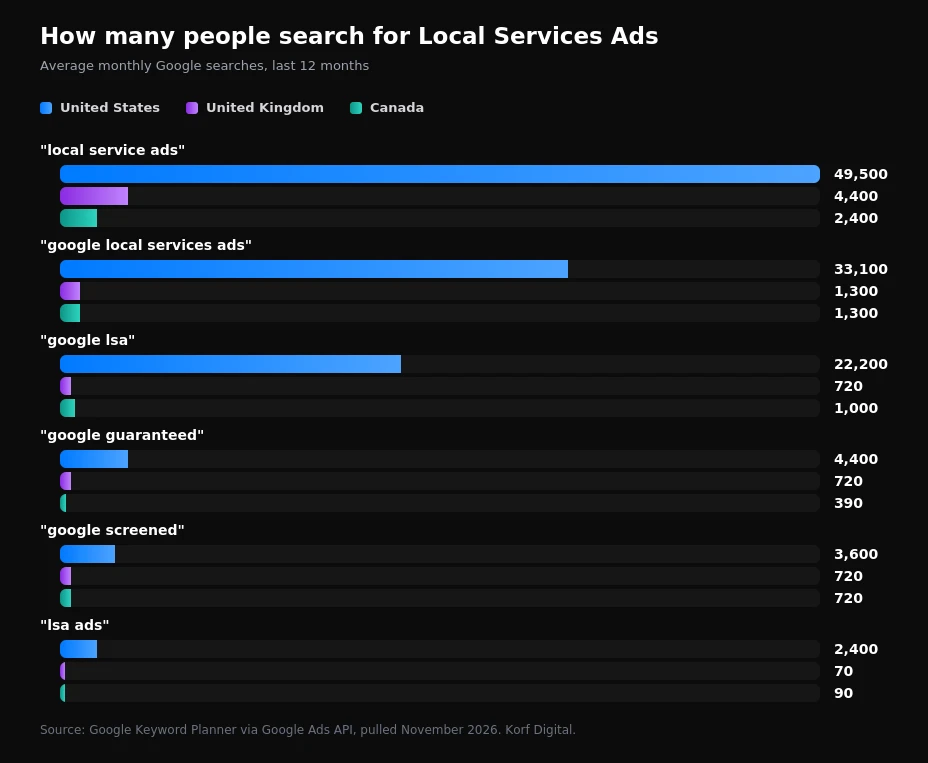
Interest follows availability: "local service ads" gets 49,500 searches a month in the US, 4,400 in the UK and 2,400 in Canada.
Checklist before you launch LSA in 2026
- Verified, public Google Business Profile with accurate hours, service area and photos.
- At least 5 reviews, ideally many more, and a routine for asking every happy customer.
- Verification documents ready: insurance and licences for your trade.
- Only the job types you actually want selected, and service areas you can really cover.
- Someone answering calls every working hour, because missed calls over 20 seconds are billed.
- Messaging switched on if you can reply fast, since responsiveness affects ranking.
- A simple log of every lead and its outcome, so you can compare it with Search.
FAQ
What is the difference between Local Services Ads and Google Ads?
Local Services Ads charge per lead and show at the top of Search and Maps based on your profile, reviews and responsiveness, without keywords or ad text. Regular Google Ads Search campaigns charge per click and let you choose keywords, write ads and send people to your own landing page. From 2026 LSA is being managed inside Google Ads too, as a Performance Max campaign type with pay-per-lead goals.
Are Local Services Ads cheaper than Google Ads?
Per lead, often yes for generic local jobs. Google does not publish LSA prices, but third-party estimates put a plumbing lead at about $57-69, while a single Search click on "emergency plumber" averages $76.38 in the US. What matters is cost per booked job, which you can only know by tracking both.
Does Google Guaranteed still exist?
No. Google replaced Google Guaranteed, Google Screened and License Verified with one Google Verified badge, and the money-back guarantee was discontinued for services booked after 7 December 2025.
Do I pay for missed calls on Local Services Ads?
Since 1 October 2026, yes: a missed call during business hours counts as a lead if the caller stays on the line for more than 20 seconds.
Can I run Local Services Ads and Search ads at the same time?
Yes. Many local businesses run both: LSA for generic demand and Search for specific high-value services, emergencies and areas LSA does not cover. Track leads from both in one place and compare cost per booked job.
Sources
Google Ads Help: "Local Services Ads transition to Performance Max campaigns with pay-per-lead goals" (2026). Google Local Services Ads Help: how leads work, budgets, ranking, verification and the Google Verified badge (2026). Search Engine Roundtable and PPC Land coverage of the migration, missed-call billing and pre-badge ads (July-October 2026). LSA cost-per-lead figures are third-party estimates from marketing vendors and are not published by Google. Search click prices and search volumes: Google Keyword Planner via the Google Ads API, average over the last 12 months, pulled in October and November 2026.
Not sure whether LSA, Search or both make sense for your business, or whether your current setup is wasting money? Start with a Google Ads audit: we check tracking, search terms and lead costs and show where the budget should go. Click prices by trade are in our guides for plumbers, roofers, HVAC, contractors and real estate agents.
Want results like this for your brand?
Get a free strategy call and a tailored proposal within one business day.
Get a Free Proposal