Nov 14, 2026
Google Ads for Small Business in 2026: What It Costs, the First 90 Days and 10 Mistakes That Burn Budgets

$1,500 a month. For a driving school in the US that budget buys about 630 clicks on Google. For a plumber it buys 44. For a personal injury lawyer, 9. Same platform, same budget, and three completely different businesses to run.
That is why generic advice about Google Ads for small business rarely helps. Whether it pays depends on your click price, your margin and what happens after the click. This guide uses our own Keyword Planner data to show what Google Ads costs a small business in 2026, what to expect in the first 90 days, and the ten mistakes that burn most small budgets.
$0.37
cheapest click in our set: "driving school"
$0.62
most expensive: "personal injury lawyer"
0 days
a fair test period before judging results
0
mistakes that burn small budgets
Google Ads works for a small business when three things are true: people already search for what you sell, the profit from one customer is clearly higher than the cost of winning one, and you can track which clicks become customers. In the US one click costs from about $2 (driving school) to $20-35 (electrician, plumber, pest control, movers) and far more for lawyers. Plan a monthly budget that buys at least 100-150 clicks, start with one Search campaign on your most profitable service, track calls and forms from day one, and judge the result after 90 days by cost per customer, not by clicks. If your break-even click price is below what your market charges, fix the offer or the conversion rate before spending more.
What a click costs your kind of business
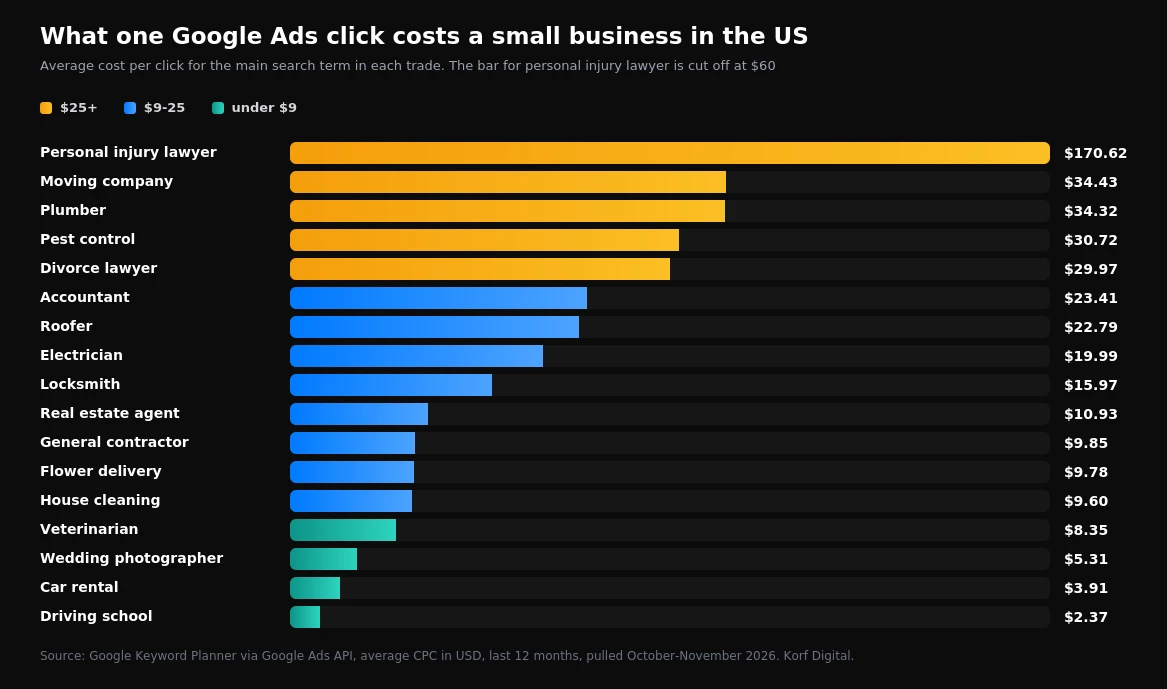
Click prices are set by an auction. The more a customer is worth and the more competitors want the same click, the higher the price. In our data three groups stand out:
- $25 and up: urgent home services and legal. Moving company $34.43, plumber $34.32, pest control $30.72, divorce lawyer $29.97, personal injury lawyer $170.62.
- $9-25: planned services. Accountant $23.41, roofer $22.79, electrician $19.99, locksmith $15.97, real estate agent $10.93, general contractor $9.85, flower delivery $9.78, house cleaning $9.60.
- Under $9: lower-ticket or less contested services. Veterinarian $8.35, wedding photographer $5.31, car rental $3.91, driving school $2.37.
These are US averages for the main search term. Specific and urgent searches cost more: "emergency plumber" averages $76.38 against $34.32 for "plumber". Outside the US prices drop sharply: the median click in the UK is about 4 times cheaper, as we show in Google Ads cost per click by country.
How much budget is enough
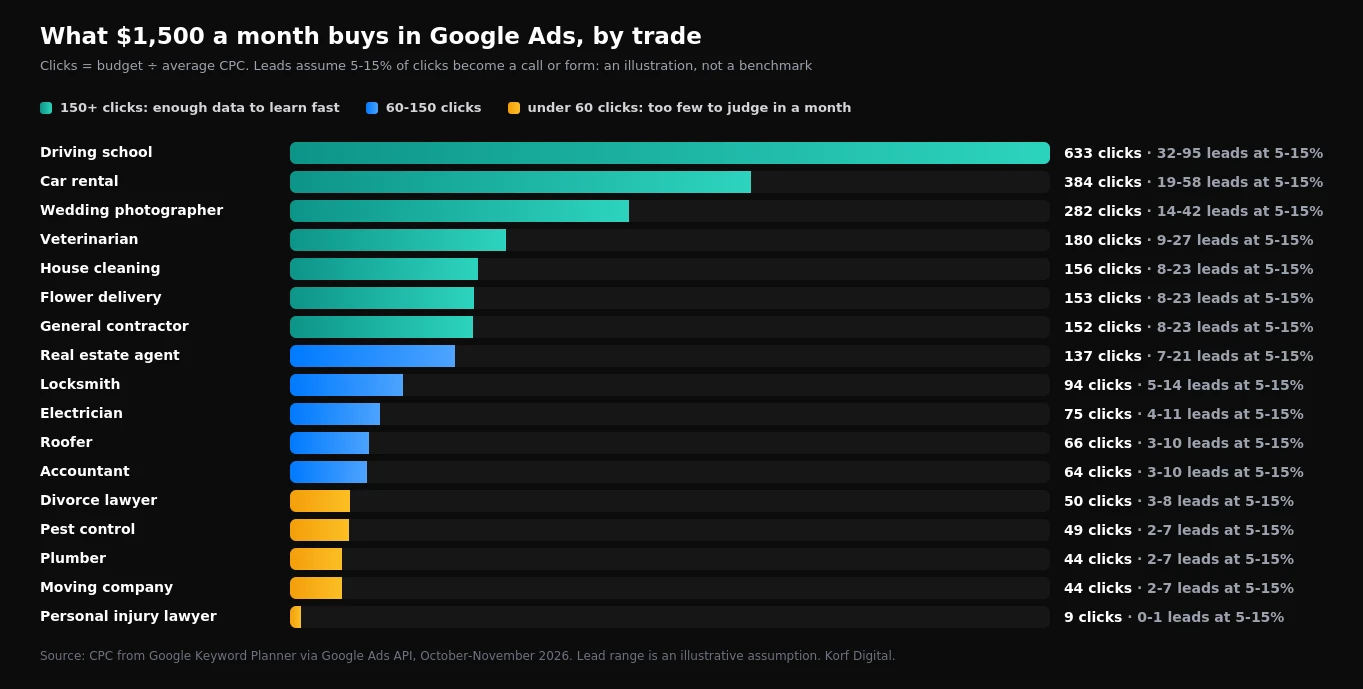
A budget is enough when it buys enough clicks to learn something. As a working rule, aim for at least 100-150 clicks a month on your main campaign. With fewer than 60 you will wait months to see whether anything works.
Minimum monthly budget ≈ 100-150 clicks × your average CPC
House cleaning: 150 × $9.60  = about $1,440
Electrician:    150 × $19.99 = about $3,000
Plumber:        150 × $34.32 = about $5,150
If that number is out of reach, do not spread a small budget thin. Narrow it instead: one service, a smaller area, the hours when you answer the phone. Forty clicks on "water heater repair" in your own town teach you more than forty clicks spread over everything a plumber does across the whole metro area.
The lead range on the chart assumes 5-15% of clicks become a call or a form. That is an illustration, not a benchmark: your landing page, offer and phone handling decide where you land.
Will it pay? Work out your break-even first
Before spending anything, calculate the most you can afford to pay for a click. If the market price is higher, ads will lose money however well they are set up.
Max cost per customer = average sale × gross margin
Max cost per lead     = max cost per customer × share of leads you close
Max cost per click    = max cost per lead × share of clicks that become leads
Break-even calculator
The default numbers are an example. Enter your own. If repeat customers are normal in your business, use what a customer is worth over a year, not one sale.
In the example above the maximum click price is $12. A house cleaner at $9.60 a click is fine. A plumber at $34.32 with the same numbers is not, unless the average job, the close rate or the conversion rate is higher. More formulas and calculators are in our guide to ROI, ROMI and ROAS.
What to expect in the first 90 days
| Period | What happens | What you should do |
|---|---|---|
| Before launch | Nothing is spent yet | Set up conversion tracking for calls and forms, check the landing page on a phone, write down your break-even numbers |
| Days 1-14 | Data starts coming in. Results swing from day to day | Check search terms every 2-3 days and add negative keywords. Do not change bids or budgets daily |
| Days 15-45 | Patterns appear: which searches, hours and devices bring leads | Pause what clearly wastes money, move budget to what brings leads, test a second ad |
| Days 46-90 | Enough leads to count customers, not just clicks | Compare cost per customer with your break-even. Switch to automated bidding only if tracking is clean and you get a steady flow of conversions |
| After day 90 | You know whether the channel pays | Scale what works, cut what does not, or stop if the math fails |
The first month is almost never the best one. Businesses that quit after two weeks usually quit before the account has learned anything.
A simple setup that works for most small businesses
- One Search campaign, one service. Start with the service that earns you the most, not with everything you do.
- Phrase and exact match keywords. Broad match with a small budget buys a lot of searches you never wanted.
- A real service area. Target where you actually work and set location to "presence", so people merely interested in your town are excluded.
- A schedule that matches your phone. Run ads when someone answers. An unanswered call is a paid click with nothing to show for it. See our day and hour analysis.
- A landing page for that service. Headline that repeats the search, price or price range if you can, phone number at the top, short form.
- Conversion tracking before the first click. Calls from ads, calls from the site and form submissions. Our call tracking guide covers the options.
- A starter list of negative keywords. Jobs, salary, free, DIY, courses. Start from our negative keywords guide.
A full walkthrough of the account setup is in how to launch Google Ads. If you run a local trade, also look at Local Services Ads, where you pay per lead instead of per click.
Ten mistakes that burn small budgets
- No conversion tracking. Without it you are paying for clicks and guessing about customers. It is also the most common problem we find in audits, see why conversion tracking breaks.
- Accepting every default. Search partners, the Display Network, automatically created assets and auto-applied recommendations are switched on for you. Review each one.
- Broad match from day one. It needs conversion data and budget to work. A new small account has neither.
- Never opening the search terms report. That is where you see what you actually paid for. See how much it costs in our search terms analysis.
- Sending everyone to the homepage. A person who searched for one service should land on a page about that service.
- Targeting too wide. A whole state or country for a business that serves three towns.
- Running ads when nobody answers. Evenings and weekends are fine only if calls are picked up.
- Starting with Performance Max. It can work well later, but without conversion history and good tracking it spends on whatever is cheapest to reach.
- Judging too early or never. Two weeks is too short. A year without checking cost per customer is too long.
- Counting leads instead of customers. Ten cheap leads that never buy are worth less than two that do. Record which leads became paying customers.
Google's own recommendations inside the account are built to increase spend as well as results. "Raise your budget" and "add broad match keywords" are suggestions, not instructions. Accept only the ones you can justify with your own numbers.
Do it yourself or hire someone
You can run a simple account yourself if you have one or two services, a modest budget and a few hours a week to learn and check it. It makes sense to get help when the budget passes a few thousand dollars a month, when tracking involves calls, forms and a CRM, or when the time you spend on ads costs more than a specialist would.
What help costs, from freelancers to agencies and offshore teams, is covered in Google Ads management cost in 2026. Whoever you hire, keep the account in your own name and pay Google directly.
Click prices, budgets, campaign structure and negative keyword lists for specific businesses: plumbers, electricians, HVAC, roofers, contractors, pest control, moving companies, cleaning services, locksmiths, real estate agents, dentists and lawyers.
FAQ
Is Google Ads worth it for a small business?
Yes, if people search for your service, your profit per customer is higher than the cost of winning one, and you track results. Work out your break-even click price first. If the market price is well above it, ads will not pay until you raise prices, close more leads or improve the landing page.
How much should a small business spend on Google Ads?
Enough to buy at least 100-150 clicks a month on your main service. At US prices that is about $1,400 for house cleaning, $3,000 for an electrician and $5,000 for a plumber. With less, narrow the campaign to one service and a smaller area.
How long does it take for Google Ads to work?
Clicks start on the first day. A fair judgment takes about 90 days: two weeks to clean up searches, a month to see patterns, and the rest to count real customers.
Can I run Google Ads myself?
Yes, for a simple account with one or two services. Set up conversion tracking first, use phrase and exact match, check search terms weekly, and do not accept automatic recommendations without checking them.
What is the minimum budget for Google Ads?
Google sets no minimum. The practical minimum is the cost of about 100 clicks a month in your niche: a few hundred dollars for a driving school, several thousand for a plumber or a mover in the US.
Methodology
Click prices: Google Keyword Planner via the Google Ads API, average CPC in USD over the last 12 months for the main search term in each trade in the United States, pulled in October and November 2026. Click counts are the budget divided by the average CPC. Lead ranges use an illustrative 5-15% conversion rate and are not measured data.
Already running ads and not sure they pay? A Google Ads audit checks tracking, search terms and settings and shows where a small budget leaks, in plain language and with numbers.
Want results like this for your brand?
Get a free strategy call and a tailored proposal within one business day.
Get a Free Proposal