Sep 23, 2026
Google Ads for Dentists: What We See in Healthcare Accounts and How to Build It Right
Dentistry is one of the most expensive niches in Google Ads, and one where advertising most often runs blind. Clicks are costly, the customer usually phones rather than fills in a form, ad wording is restricted by policy, and clinic aggregators with large budgets sit right next to you in the results. Under those conditions every setup mistake costs real money, and not every mistake is visible from the account.
During our audits we reviewed several healthcare accounts, including a dental one, and exported 12 months of data from them. Below: what a dental click costs in different countries, what we found in healthcare accounts, and how a clinic's advertising should be built so that budget turns into patients rather than numbers in a report.
$0
median top-of-page bid estimate for dental queries in the US
0%
of conversions in one dental account fired on page load
0%
of spend on Quality Score 1-4 keywords in one healthcare account
0.6%
of conversions at night on 18.7% of spend, where the conversion is a call
Dentistry combines expensive clicks with customers who phone, so two things matter most: whether conversions actually record patients, and whether budget leaks into other people's queries. In the healthcare accounts we audited, the first was the worst problem: in one dental account every conversion fired on page load, another healthcare account recorded no conversions in a year, and in a third the call tracking widget had long been returning a 404. Next by frequency: 63% to 86% of spend on keywords with a low Quality Score, a fifth of the search budget going to the Display Network, and night-time serving with no calls. The working setup for a clinic: separate campaigns by service, dense negatives, a landing page with a price for each service, call tracking with a duration threshold, a schedule matched to opening hours and a separate brand campaign.
How dentistry differs from other niches
- Expensive clicks. Implants, aligners and prosthetics are tickets worth hundreds or thousands, and the auction reflects that.
- The customer phones. A minority fill in a form, so measuring calls matters more than measuring enquiries.
- Restricted wording. Google's healthcare policy limits promises of results, and personalised advertising based on health conditions is prohibited, so remarketing for a clinic does not work the way it does for a store.
- Local intent. Patients look for a clinic within their district or city, and serving outside that area is money wasted.
- Aggregators. Clinic directories and booking services buy the same queries with large budgets and usually better Quality Scores.
What a dental click costs
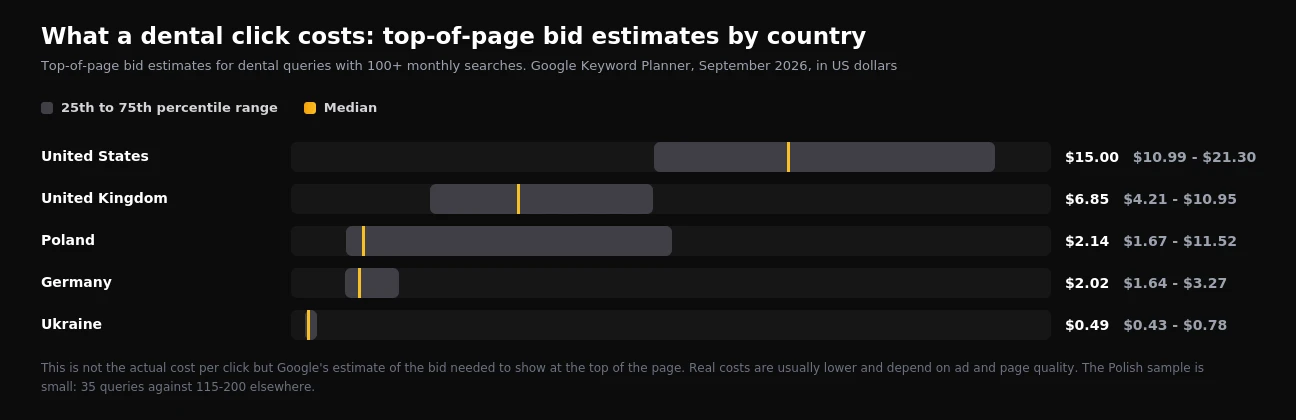
We exported top-of-page bid estimates from Google Keyword Planner for dental queries with 100 or more monthly searches in five countries. These are not actual costs per click but Google's estimate of the bid needed to reach the top positions. Real costs are usually lower.
| Country | Median | 25th to 75th percentile | Example query |
|---|---|---|---|
| United States | $15.00 | $10.99 - $21.30 | "dentist near me": up to $21.56 |
| United Kingdom | $6.85 | $4.21 - $10.95 | "invisalign": up to $15.71 |
| Poland | $2.14 | $1.67 - $11.52 | "invisalign": up to $11.52 |
| Germany | $2.02 | $1.64 - $3.27 | "invisalign": up to $5.77 |
| Ukraine | $0.49 | $0.43 - $0.78 | "aligners": up to $1.54 |
Two patterns hold in every country. First, the most expensive queries are about aligners and implants, because they carry the highest ticket. Second, generic queries such as "dentist near me" are expensive because of aggregator competition, while queries about a specific service plus a city are often cheaper and convert better.
What we find in healthcare accounts
Conversions that count nothing
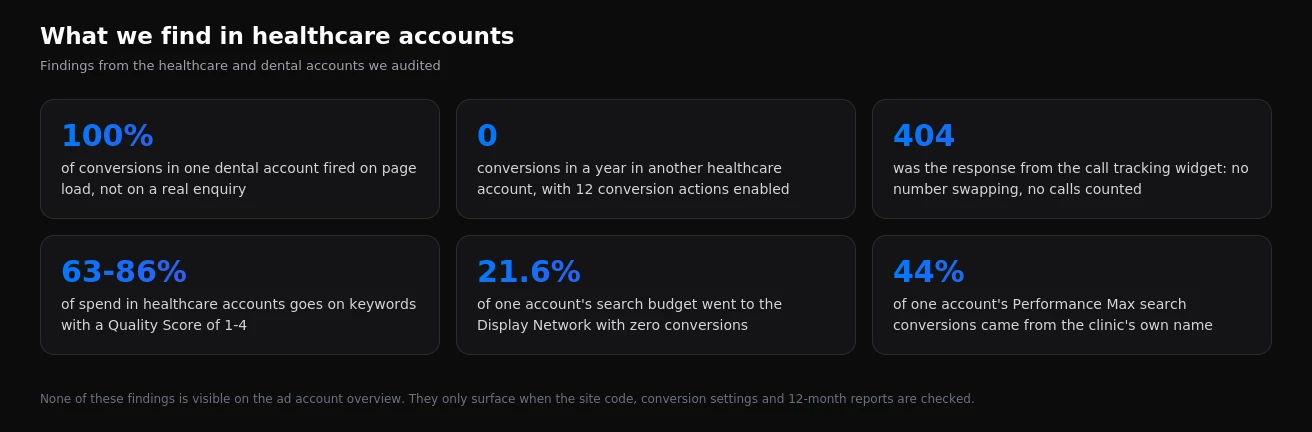
This is the main finding, and the most dangerous one for a clinic. In one dental account the only conversion action with data, a callback request through a widget, fired on every load of a service page. Not on a tap, not on a submission, but on the page simply opening. For twelve months automated bidding optimised towards page views while the reports showed an excellent cost per "lead".
It is the same story we wrote about in Performance Max against search: a fivefold jump in "leads" with no rise in spend. At the time we could only suspect the leads were not real. A check of the site code showed there were no real ones at all.
In another healthcare account, not a single conversion was recorded in a year across twelve enabled conversion actions. In a third, the call tracking widget had long been returning a 404 error: number swapping did not work, so calls could not be counted in principle. More on the typical failures in our breakdown of conversion tracking.
A good cost per lead in a report is not proof that advertising works. The only check worth anything: submit a test enquiry and make a call yourself, then reconcile the number of conversions in Google Ads with the bookings in your CRM or reception log for a month. If the account shows more conversions than real enquiries, bidding is not learning from patients.
Search queries: the structure that protects
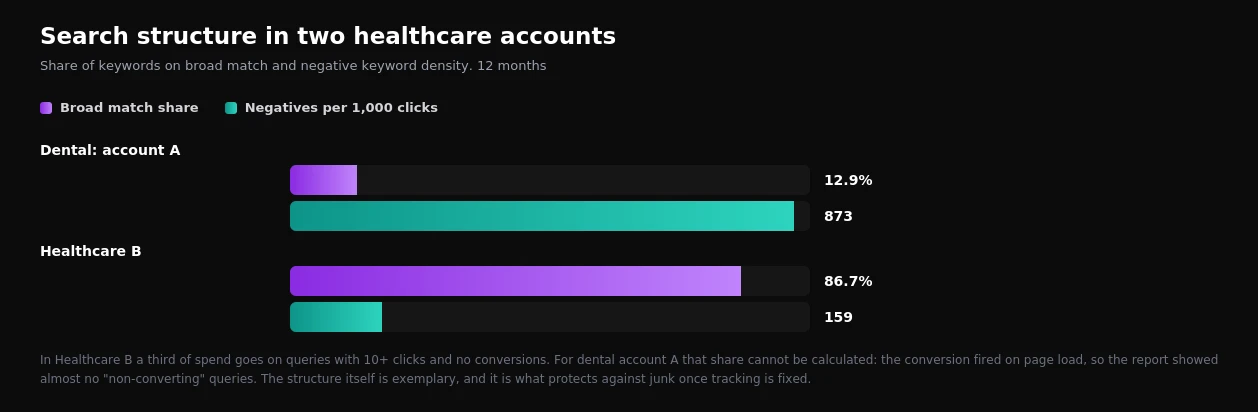
In Healthcare B a third of search spend went on queries with ten or more clicks and no conversion at all. Keywords there are 86.7% broad match, with 159 negatives per thousand clicks. The junk included other clinics' and labs' names (21% of that spend), the clinic's own brand with no conversions (10.6%), the names of doctors who work elsewhere (7.1%), and symptom queries with no intent to be treated.
Dental account A is built differently: 873 negatives per thousand clicks and only 12.9% broad match. We cannot estimate its losses on non-converting queries, because its conversions fired on page load. But that structure is exactly what protects the budget once tracking is fixed. The full breakdown is in our piece on search queries that never convert.
Quality Score
In every healthcare account we audited, between 63% and 86% of keyword spend went on keywords with a Quality Score of 1 to 4. In stores and B2B the share is 0 to 13%. The reasons are typical of healthcare: ad copy is restricted by policy and mirrors the query less closely, landing pages are often generic rather than about a specific service, and queries are phrased as symptoms. In Healthcare B, where conversions are calls, keywords scored 5-6 converted 36 times better than those scored 1-4.
Devices, schedule and calls
Mobile takes 91-94% of spend in healthcare accounts. That is normal for a niche where customers phone. But calls have a quirk: they depend on opening hours, while Google assigns a conversion to the time of the click. In Healthcare B, 18.7% of budget was spent between midnight and 7 am, and those hours brought 1.6% of conversions. Sunday cost four times the average day. Details are in our ad schedule analysis and our call tracking guide.
Two leaks invisible without segments
In one healthcare account, 21.6% of search campaign budget went to the Display Network through a checkbox enabled by default: 16,744 clicks and zero conversions. In the same account, 44% of Performance Max conversions from search came from queries containing the clinic's own name: people who were looking for that clinic anyway.
How a clinic's advertising should be built
1. Separate campaigns by service
Implants, aligners, whitening, prosthetics, paediatric dentistry, emergency care: each has its own ticket, its own intent and its own click price. A single "dentist" campaign pools them into one budget, and expensive implant queries compete for money with cheap cleaning ones. Keep a separate brand campaign with the clinic's name: it is cheap, converts best, and should not flatter the statistics of everything else.
2. Negatives before launch, not after
A baseline list for dentistry: jobs and vacancies, training and courses, free, DIY and home remedies, before-and-after photos, names of doctors at other clinics, names of other clinics and aggregators, symptom queries with no treatment intent, student essays and topics. From there the list grows weekly from the search terms report.
3. A landing page for every service
An implant page with a price or at least a range, the doctors, photos of the clinic, reviews and a booking form converts several times better than the homepage. It is also the only way to lift Quality Score in a niche where ad copy is restricted: relevance is decided by the page.
4. Calls as the primary conversion, with a threshold
A qualified call is answered, from a unique caller, and longer than 30-60 seconds. A tap on the number is a secondary action, not a primary one. Leads are counted one per click. Where Google forwarding numbers are unavailable, third-party call tracking feeding GA4 or Google Ads is needed.
5. A schedule matched to opening hours
If the conversion is a call and reception does not answer at night or on Sundays, serving at those times produces almost no patients. Either restrict the schedule or offer an alternative, such as online booking or a callback form counted as a separate conversion.
6. Local targeting
Serve within the radius patients actually travel from, plus locations of interest for queries such as "dentist Brooklyn". A patient looking for a clinic on the other side of the city will rarely make the trip.
7. Real outcomes from the CRM
The best signal for bidding is not the call but the booking and the visit. If reception marks in the CRM which call became a patient, those stages can be sent back to Google Ads through Enhanced Conversions for Leads.
What to check in your own account
| Check | Warning sign |
|---|---|
| A test enquiry and call | A conversion appears without a real action, or does not appear at all |
| Conversions against the CRM for a month | More conversions in the account than real enquiries |
| Search terms report | Other clinics' names, doctors' names, symptoms, jobs |
| Quality Score | Over half of spend on keywords scored 1-4 |
| Network segment | Display Network spend inside search campaigns |
| Schedule | Nights and weekends several times more expensive than weekdays |
| Brand | Branded queries mixed with the rest, or served in PMax with no exclusions |
Frequently asked questions
What budget does a dental practice need for Google Ads?
Work backwards: how many patients you need a month, what share of calls become bookings, what share of clicks become calls, then multiply the resulting clicks by the click price in your country. Separately, check that you reach at least 30 conversions a month; otherwise automated bidding lacks data to learn from. Market-level figures are in our piece on Google Ads costs.
Does a clinic need Performance Max?
It can work, but only with brand exclusions and verified tracking. Without those, PMax shows great numbers from people who were already looking for the clinic, or from conversions that never happened.
Can we use remarketing?
Only in a limited way. Google's policy prohibits personalised advertising based on health conditions, so audiences such as "visited the implants page" are usually unavailable or risky for healthcare. It is safer to work with search intent and brand.
Why is Quality Score low in dentistry?
Because of wording restrictions, generic landing pages and symptom-based queries. It is fixed with a page per service and tightly themed ad groups, not with bids.
What this data does not prove
A few healthcare accounts are an illustration, not market statistics. Keyword Planner bid estimates are not actual costs per click, and they vary from city to city. We deliberately left out part of dental account A's metrics, because its conversions turned out to be fake, and any conclusion about cost per conversion in such an account is worthless.
If you run advertising for a clinic and want to know whether it counts patients rather than page views, start with a one-day Google Ads, GA4 and GTM audit. And if calls and enquiries need setting up from scratch, see what our conversion tracking setup includes.
Want results like this for your brand?
Get a free strategy call and a tailored proposal within one business day.
Get a Free Proposal